What if your NDIS plan felt less like a stack of confusing paperwork and more like a clear bridge to the life you’ve always envisioned? For many families across Sydney, especially those managing high-intensity medical needs or navigating language barriers, finding the right disability support services often feels like trying to solve a complex puzzle with missing pieces. It’s completely natural to feel overwhelmed by the latest 2026 NDIS reforms or the challenge of finding staff who truly understand your cultural background and unique daily rhythms.
We understand that you’re looking for more than just a provider; you’re looking for a partner who values your dignity and agency. This guide will show you how to find personalised, culturally sensitive care that prioritises your wellbeing and simplifies the path forward. We will explore how to secure qualified staff for complex requirements and ensure clear, stress-free communication in your preferred language. By understanding the recent shift toward functional-impact assessments, you can confidently navigate the system to build a life of genuine independence and belonging within our vibrant Sydney community.
Key Takeaways
- Learn how the NDIS has shifted towards a person-centred model that puts your personal goals and choices at the heart of every decision.
- Discover why high-intensity disability support services require specialised clinical skills and registered nursing oversight to manage complex health needs safely.
- Understand the vital role of cultural sensitivity in overcoming language barriers and ensuring your support team respects your family’s heritage.
- Access a practical checklist for identifying registered providers in South Western Sydney who offer genuine local expertise and compliance.
- Find out how a dignity-first approach to care can improve your independence and foster a lasting sense of security within your community.
What are Disability Support Services within the NDIS Framework?
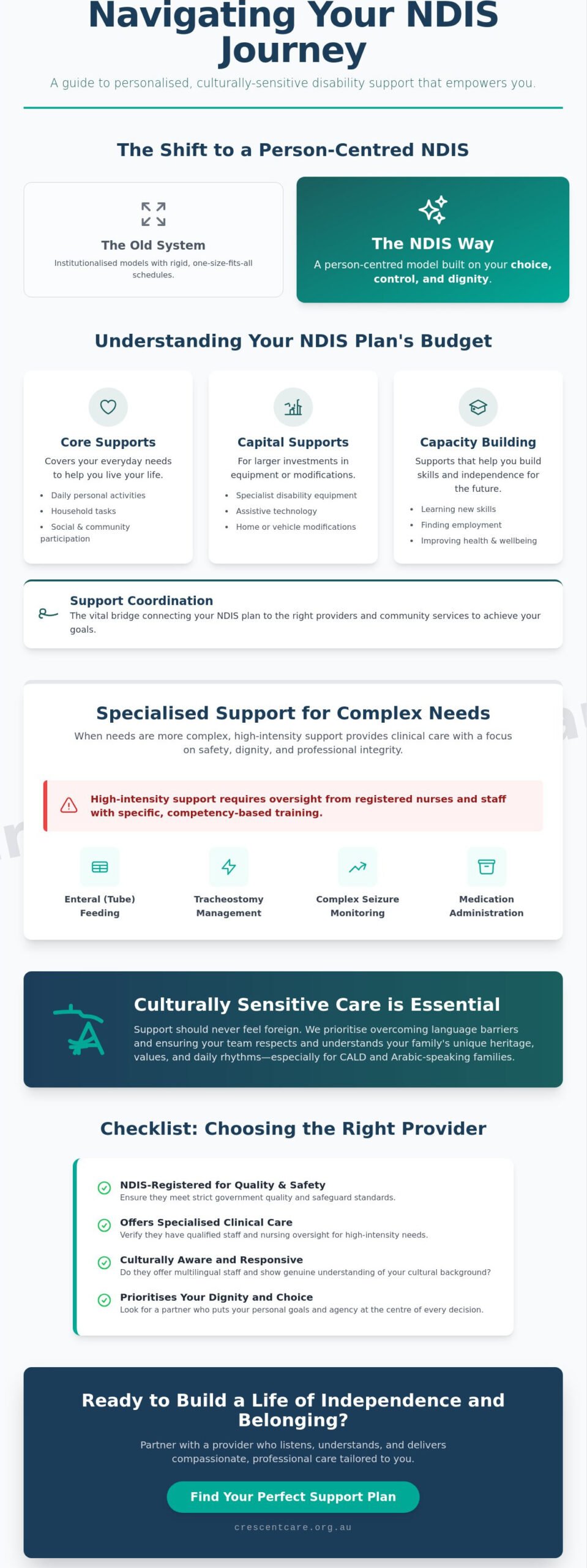
Think of disability support services as more than just assistance; they are the scaffolding that supports your personal journey toward a life of your own choosing. Instead of fitting your life into a rigid schedule, these services are designed to adapt to your unique goals and daily rhythms. This person-centred approach is the heart of the National Disability Insurance Scheme (NDIS), which replaced older, institutionalised models of care with a system built on choice and control. This shift ensures that every Australian with a disability has the agency to decide who supports them and how that support is delivered.
When you partner with NDIS-registered providers, you gain a level of security that is backed by strict quality and safeguard standards. These providers aren’t just workers; they are allies who help you navigate different life stages. Whether you’re a young person building social skills or an adult seeking greater autonomy in your own home, these services evolve as your needs change. This flexibility is vital for maintaining a sense of dignity and ensuring that your support plan remains relevant to your evolving aspirations.
Types of Support: From Daily Living to Social Inclusion
The beauty of modern disability support services lies in their versatility. For many, this begins with in-home support, where assistance with daily personal activities or household tasks ensures your living space remains a sanctuary of comfort and order. Beyond the home, community and social inclusion programs help you forge meaningful connections across Sydney, from local group activities in Parramatta to vocational support in Campbelltown. For those seeking long-term stability, options like Supported Independent Living (SIL) and Specialist Disability Accommodation (SDA) provide tailored environments where independence is nurtured through professional, specialised assistance.
Navigating Your NDIS Plan and Budget Categories
Your NDIS plan is organised into three main budget categories that help you allocate funds effectively. Core supports cover your immediate, day-to-day needs like domestic assistance or social participation. Capital supports are for significant investments, such as specialist equipment or home modifications that improve your safety and mobility. Capacity Building supports focus on the future, funding activities that help you learn new skills, manage your budget, or find employment. Support Coordination acts as the vital bridge that connects your NDIS plan with the right providers and community services to ensure your goals are actually met.
High-Intensity Support for Complex Disability Needs
High-intensity support represents a specialised tier of care within the National Disability Insurance Scheme (NDIS) framework. It’s designed for individuals whose daily lives involve significant physical or neurological challenges that require more than general assistance. This level of support often necessitates clinical oversight from registered nurses to ensure that complex health conditions are managed with the highest degree of safety and professional integrity. When a participant requires high-intensity disability support services, the focus remains firmly on their dignity. It’s about creating an environment where medical needs are met seamlessly, allowing the individual to focus on their personal growth and community connection.
Developing these complex care plans is a collaborative effort. We work closely with GPs, occupational therapists, and other health professionals to build a roadmap that is as unique as the person it serves. This ensures that every intervention is evidence-based and aligned with the participant’s broader life goals. If your family is looking for this level of dedicated, professional partnership, exploring specialised high-intensity support can provide the security you need. Our approach ensures that clinical requirements never overshadow the person at the centre of the care.
Clinical Care and Specialised Health Support
Clinical care in a home setting involves managing intricate health requirements that once required hospitalisation. This includes enteral (tube) feeding, tracheostomy management, and complex seizure monitoring. Administering and monitoring medication is another critical component, requiring precise documentation and a deep understanding of potential side effects. To maintain safety, support workers must undergo rigorous, competency-based training tailored to the specific needs of the participant. This ensures that every person providing care is not only compassionate but also technically proficient in life-sustaining procedures.
High-Intensity Daily Personal Activities
Daily life for those with complex needs often involves specialised manual handling. This requires the expert use of assistive technology, such as hoists and standing frames, to move individuals safely while preserving their comfort and skin integrity. Complex bowel and bladder management is also a key focus, where maintaining hygiene is paramount to preventing secondary health issues. Building a consistent care team is essential in this space. When the same familiar faces provide support, it fosters a deep sense of trust and allows for a stable routine that reduces anxiety for both the participant and their family.
Culturally Sensitive Support for CALD and Arabic-Speaking Families
For many families in Sydney, the concept of home is deeply tied to language, tradition, and shared values. When you’re looking for disability support services, finding a provider who understands your cultural heritage is just as vital as finding one with the right clinical expertise. In South Western Sydney, where Arabic is the most common language spoken at home other than English, the need for culturally aligned care is particularly significant. A support worker who understands your background doesn’t just provide a service; they provide a sense of security and belonging that makes the NDIS journey feel less like a bureaucratic process and more like a community partnership.
Navigating a new country while managing a disability presents unique hurdles for migrants and refugees. The complexity of the NDIS can feel like an insurmountable barrier when English isn’t your first language. Statistics from the Ageing and Disability Commission show that over 230 reports of concern in South Western Sydney involved adults who spoke a language other than English, highlighting the importance of clear communication and advocacy. We believe that your cultural identity should be a source of strength, not a barrier to accessing the care you deserve. By bridging the gap between traditional family dynamics and the Australian disability sector, we ensure that every participant feels seen, heard, and respected.
Language Support and NDIS Navigation
Families in suburbs like Liverpool and Bankstown often find NDIS terminology confusing and clinical. Our bilingual staff and professional interpreters play a crucial role in demystifying this language, ensuring you fully understand your plan and your rights. Whether it’s preparing for a plan review or explaining the nuances of budget categories, we make sure your voice is the most important one in the room. Simplifying the application process allows families to focus on their loved ones rather than getting lost in translation, making the entire experience smoother and more transparent.
Respecting Traditions in Person-Centred Care
True person-centred care means matching you with support workers who share your language and respect your family’s traditions. This extends to every aspect of daily life, from ensuring that meal preparation adheres to specific dietary requirements to respecting the privacy and modesty customs of your household. Cultural safety goes beyond just speaking the same language; it is the ongoing practice of creating an environment where a participant’s spiritual, social, and cultural needs are nurtured without judgement. This bespoke approach ensures that your disability support services feel like a natural extension of your family’s way of life.
Checklist: Choosing the Right NDIS Provider in South Western Sydney
Selecting a provider is one of the most significant decisions your family will make. It’s about finding a team that doesn’t just show up, but truly integrates into your life with empathy and skill. Start by looking for providers with deep roots in South Western Sydney. A team based in Campbelltown or Parramatta understands the local community in a way a distant agency cannot. They know the local parks, the accessible cafes, and the specific challenges of our local transport networks. This local connection is the foundation of high-quality disability support services that feel personal rather than institutional.
Safety and quality should always be your first priority. Always verify that a provider is registered with the NDIS Quality and Safeguards Commission. This registration isn’t just a badge; it’s a commitment to meeting strict Australian standards for care and accountability. Beyond the certificates, assess the management team’s communication style. Do they listen more than they talk? Are they willing to adapt their approach as your goals evolve? A provider’s flexibility is a clear indicator of their dedication to your independence. If you’re ready to partner with a team that values your agency, you can contact our South Western Sydney team to discuss a tailored support plan.
Key Questions to Ask Potential Providers
Don’t be afraid to ask direct questions during your initial meeting. You need to know how they handle the unexpected. Consider asking:
- “How do you manage emergency staffing or last-minute roster changes to ensure my care isn’t interrupted?”
- “What specific clinical training do your staff have for managing high-intensity needs like enteral feeding or seizure monitoring?”
- “Can you provide support workers who speak my preferred language, such as Arabic, and understand my cultural traditions?”
The Importance of Local Knowledge
Proximity matters more than you might think. When your provider is based in the Liverpool area, they have a better grasp of local centre-based activities and social inclusion opportunities. They can help you navigate local transport options more effectively, ensuring you remain active in your community. Local providers also build stronger networks with South Western Sydney GPs and specialists. These established relationships mean your care is better coordinated, with everyone working together to support your wellbeing and long-term goals.
Crescent Care: A Compassionate Approach to Disability Support
At Crescent Care, we believe that the best disability support services are built on a foundation of genuine human connection. Our mission isn’t just about ticking boxes; it’s about putting your dignity and agency at the heart of everything we do. We understand that every individual’s path is unique, which is why we prioritise cultural respect alongside professional reliability. In a city as diverse as Sydney, we take pride in being a steadfast advocate for those who often feel unheard in complex systems. We see ourselves as your partner, working together to turn possibilities into realities.
We have a dedicated focus on supporting the CALD community, particularly Arabic-speaking families who might find the NDIS framework daunting. For newly arrived migrants and refugees, the transition can be especially challenging. We work to simplify this journey by providing clear, empathetic guidance in your preferred language. This ensures that language barriers never stand in the way of your family’s wellbeing or independence. By bridging the gap between clinical requirements and cultural traditions, we create a space where you can feel truly understood and supported.
Personalised Support Plans That Grow With You
Our range of services is designed to evolve alongside you. Whether you need help with household tasks and domestic assistance or require specialised high-intensity support, we adapt our approach to meet your current needs. We offer everything from in-home support to community and social inclusion programs that help you build lasting connections. The Crescent Care difference lies in our blend of empathy and advocacy. We don’t just provide care; we help you achieve your unique life goals by fostering a sense of belonging and security. This real-world impact is what drives us to be a reliable, knowledgeable ally in your daily life.
Start Your Journey with Crescent Care Today
Starting a conversation with us is easy and completely pressure-free. We begin by listening to your story and understanding your specific requirements. We don’t believe in one-size-fits-all solutions. Once we have a clear picture of your goals, we focus on matching you with the right support team in your local area. This ensures that your workers aren’t just technically qualified, but also share a rapport with you and respect your cultural background. We are here to provide the continuity and reliability you deserve. Contact our warm and professional team to discuss your NDIS support needs today to see how we can walk this path together.
Embrace a Future Built on Choice and Connection
Your path toward a more independent and fulfilling life is uniquely yours. By understanding how the NDIS framework supports your personal agency and prioritising providers who respect your cultural heritage, you’ve already taken the most important step forward. Whether you’re managing complex medical needs that require high-intensity clinical oversight or simply looking for a team that speaks your language, the right partnership makes all the difference. Choosing the right disability support services in Sydney means finding a team that values your dignity as much as your safety.
As an NDIS Registered Provider and ACNC Registered Not-for-Profit, we are here to offer the professional reliability and genuine warmth your family deserves. We specialise in supporting CALD and Arabic-speaking families while providing expert care for high-intensity requirements. You don’t have to navigate this complex system alone. Partner with a compassionate NDIS provider who understands your culture and care needs-Contact Crescent Care today. We are ready to listen, adapt, and walk alongside you as you build the future you envision. Your journey of empowerment starts with a single, friendly conversation.
Frequently Asked Questions
What exactly are disability support services under the NDIS?
Disability support services are the various types of assistance and tools provided to help participants build independence and participate fully in the community. These supports range from daily personal care and household tasks to social inclusion programs and employment assistance. Under the NDIS, these services are tailored to your specific goals, ensuring you have the agency to live life on your own terms with the right scaffolding in place.
How do I know if I qualify for high-intensity disability support?
You qualify for high-intensity support if your daily care requires specialised skills or clinical oversight to manage complex health conditions safely. This usually involves needs such as enteral feeding, tracheostomy care, or complex seizure management. The NDIS determines this based on a functional impact assessment of your disability, focusing on the level of risk and technical expertise required for your daily support routines.
Can I get an Arabic-speaking NDIS support worker in South Western Sydney?
Yes, you can access bilingual support workers who speak Arabic and understand your cultural traditions. In South Western Sydney, where Arabic is a primary language for many families, we prioritise matching you with staff who share your background. This ensures that communication remains stress-free and that your household’s cultural and dietary requirements are always respected during your support sessions, fostering a genuine sense of belonging.
What is the difference between SIL and SDA in NDIS housing?
Supported Independent Living (SIL) refers to the assistance provided to help you live independently, while Specialist Disability Accommodation (SDA) is the actual physical housing designed for people with high functional needs. SIL covers the support workers who help with daily tasks in your home. SDA provides the specialised building features, such as reinforced ceilings for hoists or wider doorways, required for your safety and mobility.
How does Crescent Care help refugees and migrants with the NDIS?
We simplify the NDIS journey for refugees and migrants by providing culturally sensitive guidance and language support. Our team helps demystify complex NDIS terminology and assists with the application process to ensure language barriers don’t prevent you from accessing essential care. We act as a steadfast advocate, ensuring your cultural identity and family dynamics are central to your personalised plan from the very beginning.
Can I change my disability support provider if I am not happy?
You have the right to change your disability support services provider at any time if you feel your needs aren’t being met. Choice and control are fundamental principles of the NDIS, allowing you to switch to a partner who better aligns with your goals or cultural background. You simply need to check the notice period in your current service agreement before transitioning to a new, more suitable provider.
What role do registered nurses play in home-based disability support?
Registered nurses provide essential clinical oversight for participants with complex health requirements. They are responsible for managing intricate medical procedures, administering medication, and training support workers in technical tasks like catheter care or wound management. Their presence ensures that home-based care meets strict safety standards, providing your family with the security of knowing your loved one’s health is being professionally and compassionately monitored.
Is there support available for children with complex disability needs?
Yes, there is extensive support available for children through the NDIS early childhood approach and specialised family and child support services. These programs focus on early intervention to help children build vital skills and improve their long-term independence. We work closely with families to provide a nurturing environment that respects the child’s dignity while managing their specific clinical or developmental requirements with professional care.