
What if the biggest barrier to your family’s independence isn’t a diagnosis, but a pile of complex government paperwork? It’s completely normal to feel overwhelmed when trying to understand the ndis eligibility requirements, especially when “permanent disability” sounds so rigid or the jargon feels like a barrier rather than a bridge. You want the best for your loved ones, but the fear of being rejected because of a technicality can feel paralysing for many Sydney families. We understand that you’re looking for security and a sense of belonging, not just a list of rules.
Our 2026 guide is designed to help you navigate this process with confidence, turning that maze of requirements into a clear, supportive path forward. We’ve simplified the latest government changes so you can focus on what truly matters: your family’s wellbeing. In this article, we’ll explore the shift towards functional capacity assessments, break down the residency and age rules, and show you how a local partner can help your family feel heard and supported throughout this collaborative journey.
Key Takeaways
- Learn how the NDIS check serves as a vital gateway to accessing personalised supports like in-home care and community inclusion.
- Understand the specific ndis eligibility requirements for 2026, focusing on how a permanent disability impacts your daily functional capacity.
- Discover the essential documents you need to organise, including specialist medical reports and the Access Request Form, to ensure a smooth application.
- Find out how families from CALD backgrounds can overcome language barriers and navigate the system with culturally sensitive support.
- Identify how a local partner in South Western Sydney can provide expert guidance to help you prepare for your assessment with confidence.
What is an NDIS Check? Understanding the Basic Entry Rules
Starting your NDIS journey begins with what many call an “NDIS check.” This is the formal way the government determines if you can access funded support to live a more independent life. Think of it as a gateway that opens up possibilities for In-Home Support and Community & Social Inclusion. It’s designed to ensure that long-term funding reaches the people who need it most, providing a sense of security for your future. At Crescent Care, we often sit down with families in Liverpool and Bankstown to walk through these initial questions together. We want to make sure you feel heard and valued before you even start the paperwork. Understanding the ndis eligibility requirements is the first step toward a partnership that focuses on your dignity and goals.
Age Requirements: The 0 to 65 Rule
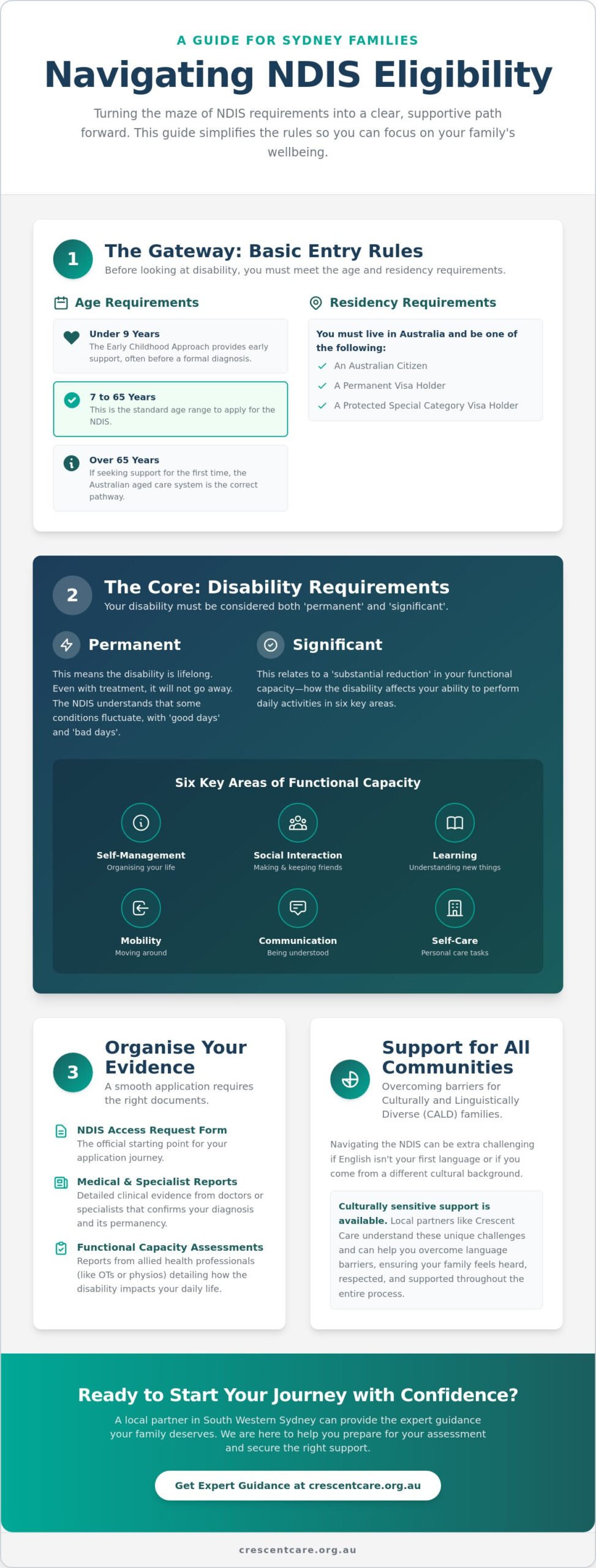
The first rule involves your age. To apply for the scheme, you generally need to be aged between 7 and 65 at the time you submit your request. If you’re supporting a child under the age of 9, the process looks slightly different. This is known as the Early Childhood Approach. It focuses on early intervention to give children the best possible start, often before a formal diagnosis is even finalised. For our community members who are already over 65 when they first seek support, the NDIS check might not be the right path. Instead, the Australian aged care system provides alternative pathways for assistance. This ensures that everyone has a safety net, regardless of which stage of life they’re in when they need help.
Residency and Citizenship: Who is Eligible?
Your residency status is another vital piece of the puzzle. To be eligible, you must live in Australia and hold Australian citizenship, a Permanent Visa, or a Protected Special Category Visa. However, “living in Australia” means more than just having a local mailing address. The National Disability Insurance Scheme (NDIS) looks at whether Australia is your permanent home and where you truly belong. This requirement helps the scheme manage its resources so that every participant can rely on consistent, local support. If your residency situation feels complicated, perhaps due to moving between countries or holding a specific visa, don’t feel you have to figure it out alone. We can help you understand how these rules apply to your unique family story, ensuring you feel confident in your standing.
The Disability Requirements: Proving Permanent and Significant Need
Proving your eligibility isn’t just about getting a doctor’s signature on a form. It’s about sharing your unique story and showing how your disability impacts your daily life. The NDIS looks for what they call a “permanent and significant” disability. This means your impairment is likely to stay with you for life and has a major effect on how you manage everyday tasks. While the official NDIS eligibility requirements focus on clinical definitions, we believe the most important part is your lived reality. It’s about the small moments, the challenges you face each morning, and the barriers that might stop you from joining in at a local community event in South Western Sydney.
A “substantial reduction” in functional capacity is the phrase the NDIS uses to describe these hurdles. They want to know if you need help from another person, or if you need special equipment to participate in social or work life. For those with complex needs, such as those requiring High Intensity Support, providing detailed clinical evidence becomes even more vital. This ensures your funding matches the level of care you truly deserve, rather than just fitting into a standard category.
Defining Permanency in Your NDIS Check
Permanency doesn’t always mean a condition stays exactly the same every single day. The NDIS understands that some disabilities fluctuate. For example, some mental health conditions or neurological disorders might have “good days” and “bad days.” To meet the ndis eligibility requirements, you must show that even with the best medical treatments available, the disability is likely to be lifelong. It’s about distinguishing a temporary injury, like a broken leg that will eventually heal, from a condition that will continue to require support and understanding for many years to come.
Understanding Functional Capacity
Functional capacity is simply a way of asking, “How does this condition affect your ability to do things?” The NDIS check looks at six key areas of your life to see where you might need a helping hand:
- Communication: Being understood by others and understanding what people are saying to you.
- Social Interaction: Making friends, maintaining relationships, and interacting with your community.
- Learning: Picking up new skills, remembering information, or practicing what you’ve learned.
- Mobility: Moving around your home safely or getting out into the Sydney sunshine.
- Self-care: Managing your personal hygiene, eating, or getting dressed each day.
- Self-management: Organising your life, making your own decisions, and staying safe.
By focusing on these activities of daily living, you can paint a clearer picture of the support you need to thrive. We’re here to listen to your story and help you find the right path toward independence and belonging.
The Essential NDIS Check Evidence List: Documents You Must Organise
Gathering the right documents can feel like a mountain to climb, but each piece of paper is a vital voice advocating for your needs. The goal is to move beyond a simple name for your condition and paint a vivid picture of how it affects your daily rhythm. While the primary document is the Access Request Form (ARF), which you complete with your doctor, the NDIS also values a diverse range of evidence. This might include reports from schools, past support workers, or therapists who see your strengths and challenges first-hand. By organising these documents thoughtfully, you ensure that the person reviewing your file understands your life, not just your diagnosis.
One of the most powerful tools you can provide is a personal impact statement. This is a “day in the life” description that explains what happens from the moment you wake up until you go to sleep. It highlights where you might struggle with tasks that others take for granted. This personal narrative helps bridge the gap between clinical data and your human experience, making it much easier to demonstrate how you meet the ndis eligibility requirements for long-term assistance.
Medical Evidence: Tips for Your GP
Your GP is often your strongest ally in this process. However, a standard medical certificate usually isn’t enough to pass an NDIS check. The NDIS needs to see “functional language.” This means your doctor should describe what you can and cannot do because of your impairment. We often suggest that families organise assessments from Occupational Therapists or Physiotherapists as well. These specialists are experts at measuring functional impact and can provide the detailed evidence the NDIS requires. When your medical team focuses on the official disability requirements, they help create a clear pathway for your application to be approved.
Family and Carer Statements
Your family knows you better than anyone else. Their perspective is incredibly valuable because they see the “informal supports” provided every day. These are the things loved ones do naturally, like helping with personal care or providing emotional stability, which often go unrecorded. Documenting this support is essential. It shows the NDIS what would happen if that family member wasn’t there to help. These statements are also a wonderful way to advocate for specific Family & Child Support. By being honest about the pressure on the household, you help the NDIS understand that meeting the ndis eligibility requirements is about supporting the whole family unit, not just one individual.
Overcoming Barriers: NDIS Access for CALD and Refugee Communities
Language should never be a hurdle that stops you from getting the support you deserve. For many Arabic-speaking families in South Western Sydney, the ndis eligibility requirements can feel like a wall of complex English jargon. This is especially true when there’s a natural hesitation or fear of dealing with large government institutions. Data from recent NDIS reports shows that about 9.2% of participants who receive a plan are from culturally and linguistically diverse backgrounds. This number highlights how vital it is for our community to have access to clear, culturally sensitive information. We believe that everyone’s voice matters, regardless of the language they speak at home.
At Crescent Care, we’ve seen how the right support can turn a confusing process into a journey of hope. We focus on your dignity and agency, ensuring you don’t feel like just another number in a bureaucratic system. Whether you’re in Liverpool, Bankstown, or Campbelltown, our goal is to make sure you feel seen, heard, and valued. We’re here to act as your steadfast advocate, helping you find a sense of belonging within the NDIS community.
Language Support and Translation Services
You don’t have to face NDIS meetings alone if you’re worried about your English. You can access TIS National, which is a free interpreting service that helps you communicate during your NDIS check. Our Arabic-speaking staff go a step further. We don’t just translate words; we simplify the entire process so you feel in control. If you have medical evidence from overseas, it needs to be correctly translated and recognised by the NDIS. We can guide you on how to get these documents ready so they clearly demonstrate your functional needs to meet the ndis eligibility requirements.
Navigating the System as a New Arrival
Newly arrived refugees often face the toughest journey. You might have incomplete medical records or feel uncertain about your rights in a new country. It’s important to remember that you have a right to disability support if you meet the residency rules. If your medical history is missing, we work with you to gather new evidence here in Australia. Community leaders also play a big role in this journey, acting as a bridge between your family and the support system. We’re proud to act as your ally, ensuring that your background is respected while you seek the independence you need. If you’re feeling stuck, our team is ready to provide culturally sensitive advocacy to help you find your way.
Starting Your Journey with Crescent Care in South Western Sydney
Taking the first step toward disability support can feel like a monumental task, but you don’t have to walk this path alone. We provide person-centered guidance to help you prepare for your NDIS check with clarity and confidence. Our team understands that the ndis eligibility requirements are about more than just checking boxes; they’re about securing the resources you need to live a life of dignity and purpose. From the moment you reach out, we act as your steadfast advocate, ensuring your voice is heard from the initial application right through to service delivery.
Our deep roots in South Western Sydney mean we’re familiar with the local landscape and the specific needs of our community. We offer local expertise across Liverpool, Bankstown, and Campbelltown, particularly for those with high-intensity needs. While government agencies can sometimes feel distant or overloaded, we offer a dedicated partnership. We help you visualise what your future could look like, whether that involves In-Home Support, Community & Social Inclusion, or moving into Supported Independent Living (SIL). Having a clear picture of these possibilities makes the application process feel less like a hurdle and more like a bridge to your goals.
Local Support Near You
We invite you to visit our centre in South Western Sydney for a face-to-face chat. There’s something uniquely reassuring about sitting down with someone who truly listens to your story. To ensure your application is as strong as possible, we coordinate closely with local health professionals, GPs, and specialists. This collaborative approach helps us gather the precise evidence needed to meet the ndis eligibility requirements. For those managing complex medical needs, we specialise in exploring NDIS High Intensity Support. We’ll help you navigate the clinical requirements so your plan reflects the true level of care you require to stay safe and well at home.
Book Your Pre-Application Consultation
Preparing for your first meeting shouldn’t be a source of stress. When you come to see us, try to bring any existing medical reports, your current ID, and any notes you’ve made about your daily challenges. We’ll help you organise your paperwork into a clear, logical format that reduces the anxiety often associated with government forms. Our friendly team is here to handle the heavy lifting of the bureaucracy so you can focus on your family’s wellbeing. You’ve already taken a brave step by learning about the system. Now, let’s turn that knowledge into action. Contact our friendly team today to start a conversation about your future and find the support you deserve.
Take the First Step Toward Your Independent Future
Understanding the ndis eligibility requirements is about more than just reading a list of rules; it’s about opening a door to a more autonomous life. We’ve explored how focusing on your functional capacity and gathering the right medical evidence can make your application much stronger. Whether you’re navigating language barriers or feeling overwhelmed by government jargon, remember that you don’t have to do this alone. Your story and your goals are at the heart of this process, and you deserve a partner who respects your unique journey.
As an NDIS-registered provider with local South Western Sydney expertise, we’re here to walk alongside you. We specialise in CALD and Arabic-speaking support, ensuring every family in our community feels seen and valued. Our team is ready to act as your steadfast advocate, helping you translate complex requirements into a plan that truly works for you. Start your NDIS journey with Crescent Care today and let’s build a path toward the independence you deserve. We’re excited to see what we can achieve together.
Frequently Asked Questions
Can I apply for an NDIS check if I am over 65 years old?
You generally cannot apply for the NDIS if you’re over the age of 65. The scheme is designed for people aged 7 to 65 at the time of their request. If you’re already 65 or older, you’ll likely find the support you need through the My Aged Care system instead. This ensures that every Australian has a dedicated pathway for assistance, regardless of their age or when their support needs first began.
What documents do I need to prove my residency for the NDIS?
To prove your residency, you’ll need to provide an Australian passport, a birth certificate, or evidence of a permanent visa. The NDIS also recognises Protected Special Category Visas for certain individuals. It’s about confirming that Australia is your permanent home. Having these documents ready before you start your check helps the process move more smoothly, giving you one less thing to worry about during your application.
How long does it take for the NDIS to decide on my eligibility?
The NDIA typically makes a decision on your eligibility within 21 days of receiving your completed Access Request Form. However, this timeframe depends on having all your supporting evidence organised and submitted correctly. If they need more information, it can take a little longer. We always recommend taking the time to gather thorough reports from your specialists first, as this often leads to a much faster and more positive outcome.
What happens if my NDIS check is rejected?
If your application is rejected, you have the right to ask for an internal review of the decision. You must do this within three months of receiving the letter. You can also submit a new application later if your circumstances change or if you gather more detailed evidence. Don’t feel discouraged; many families find that having a steadfast advocate to help refine their evidence makes all the difference in a second attempt.
Can my GP help me with the NDIS eligibility requirements?
Your GP plays a vital role in meeting the ndis eligibility requirements by completing the professional section of your Access Request Form. They provide the clinical foundation for your application. It’s helpful to ask them to focus on how your condition impacts your daily life, such as your ability to move around or manage personal care. This functional approach is exactly what the NDIS looks for when assessing your permanent and significant needs.
Does the NDIS cover temporary disabilities or injuries?
The NDIS does not cover temporary disabilities or short-term injuries, such as a broken bone that is expected to heal. The scheme is specifically tailored for people with lifelong impairments that significantly affect their independence. For temporary health issues, the Australian public health system or private health insurance are the primary sources of support. This focus ensures the NDIS remains sustainable for those who require dedicated, long-term care throughout their lives.
How do I prove that my disability is permanent and significant?
You prove your disability is permanent and significant by providing medical evidence that shows your condition is likely to be lifelong. This evidence should demonstrate a substantial reduction in your functional capacity across areas like communication, self-care, or mobility. Specialist reports from Occupational Therapists or Physiotherapists are incredibly valuable here. They paint a clear picture of your lived reality, helping the NDIS understand why you meet the ndis eligibility requirements for ongoing support.
Is there help available for Arabic speakers during the NDIS check?
Yes, there is dedicated support available for Arabic speakers, including free interpreting services through TIS National for NDIS meetings. At Crescent Care, our Arabic-speaking staff are personally invested in helping our community navigate the system with dignity. We understand the unique cultural hurdles families in South Western Sydney face. We’re here to act as a bridge, ensuring that language is never a barrier to your family’s wellbeing or independence.