
What if “home” wasn’t just a physical space, but a sanctuary where your morning greeting is a warm “Sabah el Kheir” and your traditions are understood without you ever having to explain them? For many families, the search for an Arabic speaking SIL provider Sydney is driven by a deep desire to ensure their loved one feels truly seen and respected. You likely believe that independence shouldn’t come at the cost of cultural identity, and you’re right to expect a service that honours your heritage as much as your health needs.
We understand the weight of these decisions. It’s stressful to worry about language barriers or whether Halal requirements will be respected when you aren’t there. In this guide, you’ll discover how culturally safe Supported Independent Living helps participants achieve autonomy while staying deeply connected to their roots. We’ll look at the vital role of fluent caregivers and how the right environment ensures that every tradition, from daily prayers to the celebrations of Eid, remains a vibrant part of your loved one’s life.
Key Takeaways
- Discover how Supported Independent Living (SIL) empowers you to live in a home of your own while receiving daily assistance in your primary language.
- Understand the role of the Roster of Care (RoC) in securing the NDIS funding needed to meet your specific support hours and ratios.
- See why choosing an Arabic speaking SIL provider Sydney is essential for ensuring Halal dietary needs and cultural traditions like Ramadan are fully respected.
- Learn how to identify trustworthy partners in South Western Sydney by verifying NDIS registration and a commitment to family-centred care.
- Explore the benefits of high-intensity support that prioritises your dignity and helps you maintain deep connections with your heritage and community.
What is Supported Independent Living (SIL) for Arabic-Speaking Families?
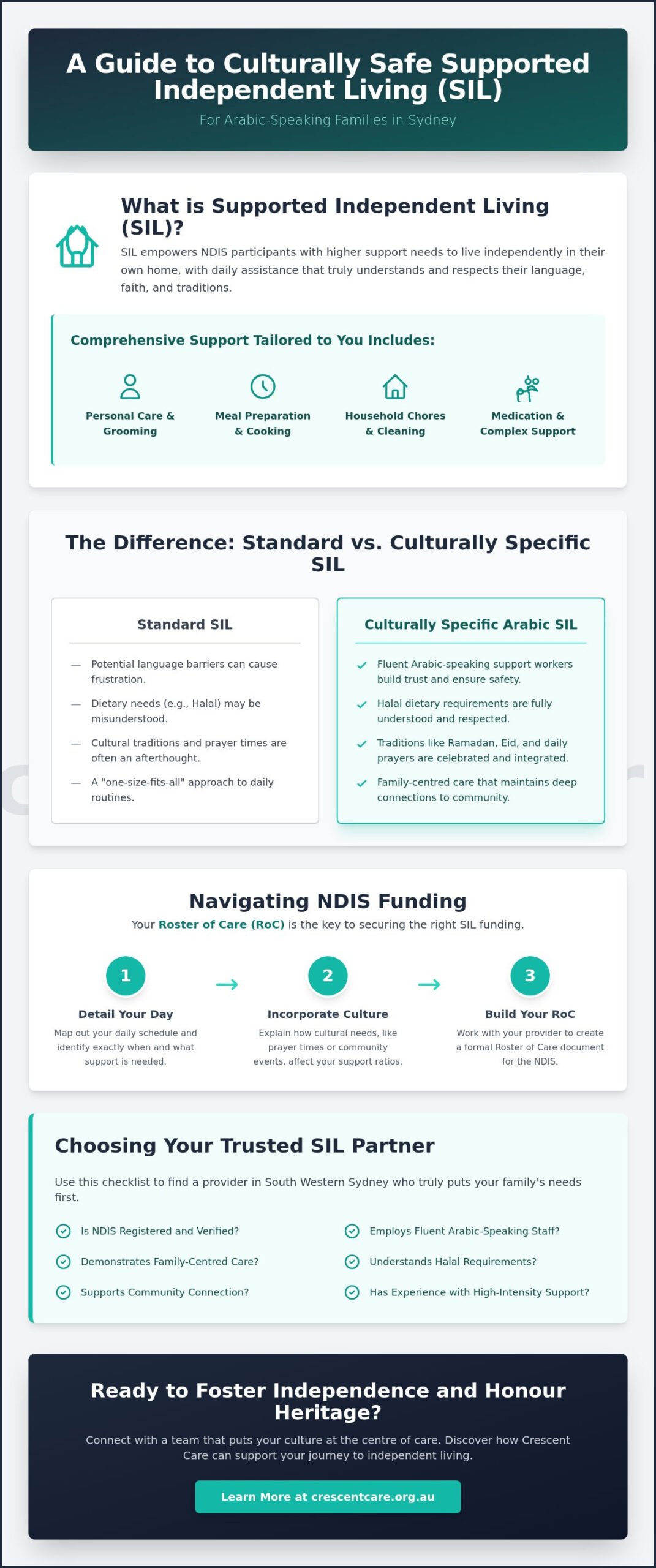
Choosing a path toward independence is a significant milestone for any NDIS participant. For families within the Arabic community, this journey often requires a partner who understands that home is where your language, faith, and traditions live. What is Supported Independent Living (SIL)? At its core, SIL is an NDIS support designed to help people with higher needs live in a shared or private home while receiving help with daily tasks. This includes 24/7 assistance that ensures your loved one is safe and supported at all times.
This support is comprehensive and includes:
- Assistance with personal hygiene and grooming to maintain dignity.
- Help with cooking and preparing nutritious meals that align with dietary needs.
- Support with cleaning and household chores to keep the home environment comfortable.
- Supervision of medication and support for complex medical requirements.
However, for those seeking an Arabic speaking SIL provider Sydney, it represents something much deeper than just a roster of tasks. It’s about creating a safe space where your culture is the foundation, not an afterthought. Culturally safe SIL ensures that your home environment mirrors your values. It means knowing that your dietary requirements are handled with care and that your daily rhythms, including prayer times, are respected by everyone in the house.
The Role of Language in Disability Support
Speaking your primary language at home is a fundamental right that directly impacts safety and well-being. When a participant can’t express their needs, discomfort, or preferences, it often leads to frustration and what the sector calls “behaviours of concern.” By communicating in Arabic, support workers can de-escalate anxiety and build a bridge of trust. This clarity is especially vital for complex medical needs. If a participant needs to explain a subtle change in their health, having an Arabic speaking SIL provider Sydney ensures nothing is lost in translation. Fluent support helps individuals maintain their identity and agency, allowing them to lead their lives with confidence.
Person-Centred Care in a Cultural Context
In our community, “person-centred” care doesn’t mean isolating the individual from their loved ones. Instead, it involves looking at the participant through the lens of their family and community. We believe the participant should always be the hero of their own story, empowered to make choices about their daily routine and future goals. A truly inclusive approach ensures that the support provided feels like a partnership with the whole family. SIL acts as a vital tool for autonomy that respects one’s cultural roots while fostering genuine independence.
Navigating NDIS Funding and the Roster of Care (RoC)
Securing the right funding for Supported Independent Living is often the most technical part of your NDIS journey. The Agency allocates funding based on support ratios, which essentially means how many staff members are present for a specific number of participants. To formalise this, you must develop a Roster of Care (RoC). This document is a detailed weekly schedule that outlines exactly when and how your support is delivered, from the moment you wake up until you go to sleep.
Building this roster requires a deep understanding of your daily life. If you’re working with an Arabic speaking SIL provider Sydney, they can act as a bridge during this process. They’ll help you articulate why certain times of the day require more support, such as during community prayers or important family gatherings. Without this cultural lens, your RoC might look like a clinical list of tasks rather than a reflection of your lifestyle. You might find it helpful to chat with a specialist who can help translate your needs into the language the NDIS understands.
Overcoming the Language Barrier in Planning
Communicating your family’s specific cultural needs to NDIS planners can feel daunting if there’s a language gap. It’s helpful to be very specific about how culture impacts your safety and well-being. Using an NDIS-registered provider who understands CALD requirements is a major advantage. They’re familiar with the NDIS Cultural and Linguistic Diversity Strategy, which is a government initiative designed to ensure services are accessible to everyone. This knowledge helps you secure enough funding for social inclusion activities that actually matter to you, like visiting a local community centre or attending cultural festivals.
High-Intensity Support for Complex Needs
Some participants require more specialised care, often referred to as high-intensity support. This includes complex disability supports like tracheostomy care, seizure management, or feeding through a tube. For these needs, the accuracy of your RoC is even more critical. Having registered nurses who can explain these medical procedures in Arabic provides immense peace of mind for the whole family. It removes the fear of the unknown and ensures everyone is on the same page regarding care. For a deeper look at these services, you can read more about NDIS high intensity support and how it’s tailored to individual needs.
Standard SIL vs. Culturally Specific Arabic Support
While many organisations offer quality care, there’s a world of difference between a standard service and one that’s deeply rooted in your heritage. A standard provider might focus on the clinical tasks of your day, such as personal hygiene or medication management. In contrast, an Arabic speaking SIL provider Sydney acts as a cultural companion. They don’t just see a participant; they see a person with a history, a faith, and a specific way of connecting with the world.
This familiarity has a profound impact on long-term mental health. When you don’t have to explain why certain customs matter, your home becomes a true place of rest. Religious observance, such as daily prayer times or Friday Jumu’ah, isn’t treated as an interruption to a schedule. Instead, it’s integrated seamlessly into the rhythm of the house. This level of understanding prevents the social isolation that often occurs when participants feel like “outsiders” in their own living spaces.
Dietary Needs and Halal Living
For many families, Halal is more than a dietary choice; it’s a core component of daily life and spiritual well-being. A culturally specific provider ensures the entire kitchen environment respects Islamic guidelines. This means support workers are trained to avoid cross-contamination and understand the nuances of meal preparation. Beyond the rules, there’s the joy of traditional food. Whether it’s the aroma of fresh flatbread or a slow-cooked stew, these meals provide a sensory connection to home. Providers should organise grocery shopping trips to trusted local butchers and grocers who provide the high-quality, authentic ingredients your family prefers.
Celebrating Traditions: Ramadan, Eid, and Family
Living independently shouldn’t mean missing out on the community’s most significant moments. A dedicated Arabic speaking SIL provider Sydney will help you stay active in local hubs like Bankstown and Liverpool. During Ramadan, this might involve adjusting support hours for Suhoor and Iftar, or facilitating visits to the mosque. When Eid arrives, the home should be a place of celebration where family is welcomed with open arms. By maintaining these social links, we ensure that participants remain vital members of the wider community, surrounded by the people and traditions they love most.
Finding an Arabic Speaking SIL Provider in Sydney
Finding the right home is a journey that requires both heart and due diligence. When you begin your search for an Arabic speaking SIL provider Sydney, focusing on areas with a strong community presence is a smart first step. South Western Sydney is often the preferred choice because it offers unparalleled access to cultural hubs, specialised medical centres, and familiar social circles. Beyond location, you should verify a provider’s credentials. It’s essential to ensure they are NDIS-registered, especially since mandatory registration becomes a legal requirement for all SIL providers by July 1, 2026. Checking for ACNC not-for-profit status can also offer an extra layer of trust, as it often reflects a commitment to community well-being over corporate profit.
Experience with newly arrived migrants and refugees is another vital factor to consider. Families who have recently settled in Australia often face unique challenges, from navigating a new healthcare system to overcoming past trauma. A provider who understands these nuances can offer more than just physical care; they provide a sense of safety and belonging. We encourage you to visit potential homes in person. You can’t truly feel the “vibe” of a place through a website alone. Take the time to meet the staff, observe the interactions, and see if the environment feels like a genuine home where your loved one will thrive.
Key Locations: From Liverpool to Bankstown
Suburbs like Liverpool and Bankstown are the beating heart of the Arabic-speaking community in Sydney. Living in these areas means being close to local mosques, community centres, and specialist medical hubs where staff often speak multiple languages. It’s about more than just a house; it’s about being part of a neighbourhood that feels familiar and welcoming. For those looking specifically at the supported independent living liverpool area, you’ll find a community that is exceptionally well-equipped to support culturally diverse needs with compassion and local expertise.
Questions to Ask Your Potential Provider
To ensure you’re making the best choice for your family, don’t be afraid to ask direct questions during your tour. A transparent and reliable provider will always welcome your curiosity. You might want to ask:
- “How many of your staff speak fluent Arabic, and will they be on-site during every shift?”
- “How do you handle Halal meal prep and the celebration of religious holidays like Eid?”
- “Can you help us navigate the NDIS review process if our family member’s needs change over time?”
If you’re feeling overwhelmed by these choices or simply want to explore your options, you can book a consultation with our team to discuss your specific goals in a supportive, pressure-free environment.
Why Crescent Care is Your Partner in Independent Living
Crescent Care isn’t just another service provider. We are a deeply rooted part of the South Western Sydney community. Our heritage is built on the belief that everyone deserves a home where they feel safe, understood, and respected. As a dedicated Arabic speaking SIL provider Sydney, we bridge the gap between complex NDIS processes and the cultural warmth your family expects. We don’t just see a participant; we see a person with a rich history and a bright future.
We recognise that for many Arabic-speaking families, the traditional clinical model of care feels distant. That’s why we champion a “Family-as-Partner” model. In our culture, the family is the heart of the support network. We don’t work in isolation. Instead, we collaborate closely with you to ensure your loved one’s dignity and agency are always at the forefront. Whether we are providing high-intensity support for complex medical needs or assisting with daily household tasks, our team treats every individual like a member of our own family.
A Shared Journey to Independence
Our goal is to empower our participants to lead lives of their own choosing. We facilitate independent living in sydney by focusing on what’s possible, not just what’s required. This means prioritising social inclusion and helping participants stay connected to the community hubs they love. Our 2026 commitment ensures that every Arabic-speaking participant in Sydney has access to registered, culturally safe housing that feels like a true sanctuary. We believe that independence is a shared journey, and we are honoured to walk that path beside you.
Start Your Conversation with Us
Reaching out for support shouldn’t feel like a transaction. We invite you to start a friendly, no-pressure conversation with us in either Arabic or English. We’ll take the time to listen to your story and understand your family’s unique goals. Transitioning into a Crescent Care SIL home is a methodical, calming process designed to reduce stress for everyone involved. We promise to be your steadfast advocate, providing unwavering support and ensuring your loved one has the tools they need to flourish. Your peace of mind is our priority, and your family’s success is our greatest reward.
Embracing a Future of Belonging and Independence
Finding the right home is a journey that should lead to a place where you feel completely yourself. You’ve seen how Supported Independent Living is more than just a service; it’s a way to ensure your loved one thrives while staying connected to their heritage. By choosing an Arabic speaking SIL provider Sydney, you’re prioritising clear communication, Halal dietary needs, and the celebration of traditions that make life meaningful. Whether it’s navigating the technicalities of the Roster of Care or finding a home in the heart of South Western Sydney, the goal is always the same: dignity and autonomy.
As an NDIS Registered Provider and ACNC Registered Not-for-Profit, we are specialists in CALD and Arabic-speaking disability support. We understand the importance of family and the comfort of a shared language. We are here to act as your compassionate guide and steadfast advocate every step of the way. Begin your journey to independence with Crescent Care today. We look forward to building a bright and secure future together.
Frequently Asked Questions
What is the difference between SIL and SDA in the NDIS?
SIL funding pays for the people who help you with daily tasks, whereas SDA funding pays for the physical home you live in. It’s easiest to think of it this way: SIL is about the support, and SDA is about the bricks and mortar. Most participants who require specialist housing will have both in their plans to ensure they have the right environment and the right care team.
Can I choose a SIL provider that speaks Arabic even if I live outside South Western Sydney?
You can absolutely choose an Arabic speaking SIL provider Sydney regardless of where you currently live. While many of our homes are located in hubs like Liverpool or Bankstown for better community access, we support participants from across the city. The most important factor is finding a team that understands your cultural identity and can provide the specific linguistic support you need to feel safe.
How does Crescent Care ensure Halal dietary requirements are met in SIL homes?
We maintain strict standards for Halal meal preparation by training our staff in Islamic dietary laws and cross-contamination prevention. Our team sources fresh produce and meat from trusted local Halal-certified suppliers in South Western Sydney. This ensures that every meal served in our homes respects your religious requirements and provides the familiar, traditional flavours that make a house feel like a home.
Will my family still be involved in my care if I move into a SIL home?
Family remains the cornerstone of our support model, and we encourage your loved ones to be as involved as you wish. Moving into a SIL home doesn’t mean moving away from your family; it means gaining independence with their support. We facilitate regular visits, involve family in planning meetings, and ensure that your cultural and family traditions are always celebrated within your new home.
What happens if my NDIS plan doesn’t currently have SIL funding?
If your NDIS plan doesn’t include SIL funding, you’ll need to go through a plan review process to demonstrate that this support is “reasonable and necessary.” Our team can help you gather the required evidence, such as occupational therapy reports or assessments of your daily living needs. We’ll guide you through the technical steps to ensure the NDIS understands why a culturally safe home is vital for your autonomy.
How do you match participants with Arabic-speaking support workers?
Matching is a thoughtful process where we consider your personality, interests, and specific Arabic dialect. We don’t just assign a worker; we look for a “cultural companion” who can build a genuine bond with you. By pairing you with someone who shares your language and values, we create an environment where communication is easy and your daily life feels natural and comfortable.
Can Crescent Care help me understand my NDIS plan in Arabic?
Yes, our bilingual team is here to walk you through every detail of your NDIS plan in your preferred language. We understand that NDIS terminology can be complex, so we translate these concepts into clear, accessible Arabic. This ensures you and your family have total clarity on your funding, your rights, and how your supports are being delivered, giving you full control over your journey.
Is there a waiting list for Arabic-speaking SIL homes in Sydney?
Availability for an Arabic speaking SIL provider Sydney can change quickly, so it’s best to contact us to discuss current vacancies. While some homes may have a waiting list, we are constantly working to expand our housing options to meet community needs. Starting the conversation early allows us to help you plan for the future and ensure a smooth transition when the right home becomes available.