

What if taking a break wasn’t a sign that you’re struggling, but the very thing that keeps your family’s heart beating strong? For many Sydney carers, the thought of stepping away feels heavy with guilt or the fear that a stranger won’t understand your loved one’s specific needs. You might find yourself exhausted by complex jargon or worried that a language barrier will get in the way of genuine support. It’s a common feeling, yet sustaining your own health is essential for the long-term happiness of everyone in your home.
We understand that you want more than just a bed for the night; you want a place where your family member is seen, heard, and valued. This guide explores how to access respite care ndis, now officially known as Short Term Respite, to help you regain your spark while your loved one enjoys social inclusion and professional care. We’ll walk you through the 2026 guidelines, the 28-day annual limits, and the simple steps to include this vital support in an NDIS plan. Together, we can organise a path that brings balance back to your life and ensures your loved one continues to grow in a safe, welcoming environment.
Key Takeaways
- Understand why Short-Term Accommodation is now called Short Term Respite and how this shift prioritises the wellbeing of informal carers.
- Compare the benefits of 24-hour stays away from home with the comfort of receiving dedicated In-Home Support in your own familiar surroundings.
- Learn how to gather the right evidence from therapists and doctors to ensure respite care ndis is recognised as a reasonable and necessary support.
- Identify the key qualities to look for in a Sydney provider, including cultural competence and deep roots in the local South Western community.
- Discover how a well-structured respite plan can prevent carer burnout while fostering social inclusion and independence for your loved one.
What is Respite Care under the NDIS?
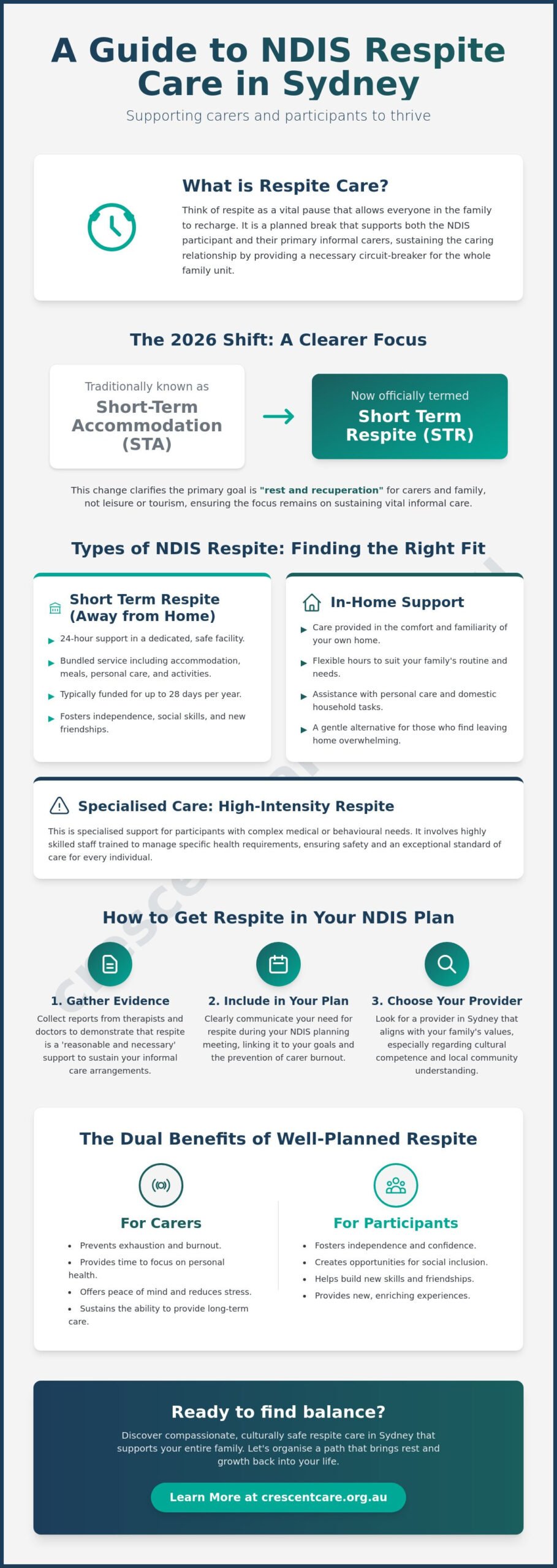
Think of respite as a vital pause that allows everyone in the family to recharge. At its core, What is Respite Care? It’s a temporary, planned break that supports both the NDIS participant and their primary informal carers. Accessing respite care ndis is a dedicated support that sustains the caring relationship by providing a necessary circuit-breaker for the whole family unit. Whether it happens in your own home in Austral, a centre-based setting in Liverpool, or specialised accommodation across Sydney, it provides a safe space for both growth and rest.
In the language of the NDIS, this support has traditionally been funded as Short-Term Accommodation (STA). However, the focus is always on the person, not just the bureaucratic process. It’s about finding a rhythm that works for your unique family dynamic. By stepping away for a short period, carers can attend to their own health and wellbeing. At the same time, participants gain fresh opportunities for social inclusion and skill-building in a supportive, professional environment.
The Shift to Short-Term Respite (STR) in 2026
As of 2026, the NDIS has transitioned to using the term Short Term Respite (STR) more broadly to better reflect the true purpose of the funding. This shift clarifies that the support’s primary goal is “rest and recuperation” rather than leisure or tourism. The current guidelines mean that when you access respite care ndis, the funding covers a bundled package of support. This includes your accommodation, personal care, meals, and any activities that are already part of your disability support plan. It’s a streamlined way to ensure the focus remains on sustaining the informal care arrangements that are so important to your family’s stability.
Why South Western Sydney Families Need Culturally Safe Respite
For families in vibrant hubs like Liverpool and Bankstown, care is often a deeply personal, multi-generational commitment. We recognise that “carer burnout” can feel especially heavy when you’re also managing language barriers or the challenges of settling in a new country. Culturally safe respite isn’t just a luxury; it’s essential for your peace of mind. It means finding support workers who speak your language, understand your traditions, and respect your family’s daily routines. For newly arrived migrants and refugees, this culturally sensitive approach provides a sense of security. It allows you to take a necessary break without the anxiety of leaving your loved one with someone who doesn’t understand your world.
Types of NDIS Respite: Finding the Right Fit for Your Family
Choosing the right support isn’t about fitting into a box; it’s about finding a service that respects your family’s unique lifestyle. In Sydney, respite care ndis options are diverse, ranging from a few hours of help at home to stays in a dedicated facility. Whether you live in a quiet street in Austral or a busy hub like Liverpool, the goal is to provide a safe, nurturing environment that feels like a natural extension of your care.
For some, the best fit is High-Intensity Respite. This specialised care is designed for participants with complex medical or behavioural needs who require more than just standard assistance. It involves skilled staff who are trained to manage specific health requirements or provide intensive behavioural support. We believe that everyone deserves a high standard of care, regardless of the complexity of their needs, ensuring that no family is left to manage these challenges alone.
Short-Term Accommodation (STA) Explained
Often referred to as Short Term Accommodation, including respite, this option provides 24-hour support away from your usual residence. It’s a bundled service that covers your accommodation, meals, personal care, and activities. Under current NDIS guidelines, most plans fund up to 28 days of Short Term Respite per year. This allows participants to build independence and socialise in new settings, often making lifelong friends while their primary carers take a well-earned rest.
In-Home Support and Domestic Assistance
If leaving the house feels overwhelming, in-home support offers a gentler alternative. A dedicated support worker can visit your home in suburbs like Rossmore or Austral to assist with household tasks and domestic assistance. This flexibility allows you to rest in another room or attend to other responsibilities while knowing your loved one is safe in their familiar environment. It’s an excellent choice for participants who find changes to their routine difficult to manage.
Community-based respite is another wonderful path, where participants join social groups or centre-based activities during the day. This fosters social inclusion and helps develop new skills in a vibrant, community setting. If you’re unsure which path is right for you, we invite you to chat with our friendly team about how to tailor these supports to your specific goals.
Eligibility and Funding: How to Get Respite in Your NDIS Plan
Securing funding for respite care ndis isn’t just about ticking boxes; it’s about telling your family’s story with clarity and heart. The NDIA uses the “Reasonable and Necessary” test to decide if a support is right for you. This means you need to show how a break helps the participant reach their specific goals while keeping the family unit stable. Usually, this funding sits within your Core Supports budget under the category “Assistance with Daily Life.”
The NDIS recognises that informal supports, like mums, dads, and siblings, are the backbone of a participant’s life. To protect these vital relationships, the agency looks for evidence that respite will prevent carer burnout. To understand the official criteria and how the agency views these breaks, it helps to review What is short-term respite as defined by the NDIA. Having this foundational knowledge ensures you’re using the right language during your planning meeting or review.
Preparing for Your NDIS Plan Review
Preparation is your best tool for a successful review. We suggest keeping a “carer fatigue” diary for a few weeks before your meeting. Document the hours of support you provide and how exhaustion impacts your health or your ability to care long-term. When you speak with your Local Area Coordinator (LAC), link the need for respite care ndis to concrete goals. For example, instead of just asking for a break, explain how a stay away from home will “increase independence” or “improve social skills” for the participant. Reports from your Occupational Therapist, psychologist, or GP that specifically mention carer stress are also incredibly powerful pieces of evidence.
Respite for High-Intensity and Complex Needs
If your loved one has complex medical requirements, the eligibility process involves extra layers of safety. For participants who require PEG feeding, tracheostomy care, or ventilator support, the NDIS may fund High Intensity Support. This often requires a Registered Nurse to be involved in the care plan or even provide direct support during the respite period. When applying for this, you’ll need detailed clinical reports outlining the specific risks and the level of expertise required to manage them. Ensure your chosen provider is specifically registered for high-intensity care. This guarantee of safety allows you to truly rest, knowing that every clinical need is being met by a qualified professional who understands the technical side of care as well as the human side.
Choosing an NDIS Respite Provider in Sydney
Finding a partner for your family’s journey is a deeply personal choice. In Sydney, you have many options, but location is a practical starting point for most families. Staying close to home in areas like Liverpool, Campbelltown, or Bankstown makes the transition much smoother for everyone involved. When you choose a local provider for respite care ndis, you reduce travel stress and keep your loved one connected to their familiar community. This proximity allows for a gentler introduction to new surroundings, making the experience feel less like a clinical appointment and more like a supportive extension of home.
We encourage you to look beyond standard facilities that often offer a one-size-fits-all experience. Instead, seek out person-centred care where your loved one’s dignity and agency are the true priority. This involves checking if the provider is registered with the NDIS Quality and Safeguards Commission, which ensures they meet strict safety and quality standards. A truly compassionate provider will treat your family like partners, adapting their support to fit your specific traditions and routines rather than forcing you to adapt to theirs.
The Importance of Arabic-Speaking Support
For many families in South Western Sydney, language is the bridge to trust. When a support worker speaks your native tongue, it immediately lowers anxiety for both the carer and the participant. If you’re looking for an Arabic speaking SIL provider in Sydney, you might find they also offer respite services that respect your cultural values. This includes ensuring Halal dietary requirements are strictly followed and that daily prayer routines or cultural traditions are honoured during a stay. Clear communication ensures that small details, like how a meal is prepared or how a person likes to be greeted, are never lost in translation.
Questions to Ask Potential Providers
Before you commit, it’s vital to have an open conversation. Don’t be afraid to ask direct questions to ensure the fit is right for your family’s peace of mind. You might want to include these in your initial chat:
- What is the staff-to-participant ratio during the respite period?
- How does your team handle medical emergencies or complex behavioural episodes?
- Can our family visit the accommodation or meet the assigned support worker before the stay begins?
These questions help you feel secure in your decision and ensure the provider can meet your specific needs. If you’re ready to explore how we can support your family with a bespoke approach, contact our Sydney team today to discuss a personalised plan that puts your wellbeing first.
Crescent Care: Your Local Partner for Compassionate Respite
Choosing a partner for your family’s care is a decision made with the heart as much as the head. At Crescent Care, we believe that support is most effective when it’s rooted in the community it serves. Our heart-centred approach to disability support in South Western Sydney is built on the understanding that every family’s journey is unique. We don’t just provide a service; we build a dedicated partnership that prioritises the dignity, agency, and person-centred outcomes of every individual we serve. Whether you’re in Liverpool or the surrounding suburbs, our goal is to ensure that accessing respite care ndis feels like a natural, supportive step forward for your entire family unit.
We take our role as advocates seriously, especially for those from Culturally and Linguistically Diverse (CALD) backgrounds. We know that the NDIS can feel like a maze, particularly for newly arrived families who are also balancing the challenges of settling into a new country. Our team is deeply committed to CALD community advocacy, ensuring that language or cultural differences never stand in the way of essential support. We work alongside you to ensure your traditions are respected and your voice is heard throughout the entire planning process.
High-Intensity Support You Can Trust
Our team includes experienced professionals who are specifically trained in complex care delivery. We understand that families managing high-intensity needs require a higher level of clinical expertise and trust. Whether it’s technical health requirements or intensive behavioural support, we provide a safe and warm environment where your loved one can thrive. For those just beginning to find their way, we offer specialised NDIS application help for refugees in Sydney. This assistance ensures that even the most complex clinical needs are documented correctly so you can access the funding your family deserves.
Taking the Next Step with Crescent Care
Accessing a break shouldn’t be a source of paperwork-induced stress. We’re here to help you navigate the bureaucracy and planning required to include respite care ndis in your plan. You can book a consultation at our Liverpool or South Western Sydney locations to discuss your goals in a relaxed, welcoming environment. We’ll listen to your family’s values and help you organise a tailored respite plan that provides the rest you need while fostering growth for your loved one. Contact our friendly team today to start a conversation about a support plan that truly sees, hears, and values your family.
Embracing a Balanced Path for Your Family
Finding the right balance in your caring journey is a profound act of love for both yourself and your family member. We’ve explored how the shift to Short Term Respite (STR) clarifies the NDIS’s commitment to carer wellbeing and why choosing a provider who understands your language and traditions makes all the difference. By documenting carer fatigue and linking your needs to clear goals, you can successfully include respite care ndis in your plan to ensure long-term stability and peace of mind.
As an NDIS-registered provider and ACNC-registered not-for-profit, we’re dedicated to being the steadfast advocate your family deserves. Our team includes Arabic-speaking specialists who ensure that no detail of your cultural or clinical care is lost in translation. You don’t have to navigate these complex systems alone; we’re here to walk beside you every step of the way, providing the professional reliability you need to feel secure.
Book a compassionate consultation with the Crescent Care team today to start building a support plan that honours your values and restores your energy. You deserve a partner who sees your dedication and supports your strength with genuine care and expertise.
Frequently Asked Questions
Is respite care the same as Short Term Accommodation (STA)?
Yes, the NDIS usually funds respite care under the category of Short Term Accommodation (STA), which was officially renamed Short Term Respite (STR) in late 2025. This support is a bundled service that includes your accommodation, meals, and personal care in a safe environment away from your usual home. It’s designed to give both you and your informal carers a necessary break to recharge.
How many days of respite care can I get per year under the NDIS?
Most NDIS plans allow for up to 28 days of Short Term Respite per year. You have the flexibility to use these days in a way that best suits your family’s needs, such as one weekend every month or a longer stay of up to 14 days at a time. This allows you to plan for regular rest or specific events where extra support is required.
Does the NDIS pay for a holiday for my carer?
No, the NDIS doesn’t fund holidays, flights, or leisure activities for carers or participants. The funding for respite care ndis is specifically intended to cover the cost of the participant’s support and accommodation. While the carer benefits from the break, the money is used to ensure the participant is safe and well-cared for in a professional setting.
Can I get NDIS respite care if I have high-intensity medical needs?
Yes, you can absolutely access respite care if you have complex medical or behavioural requirements. You’ll need to ensure your provider is registered for High Intensity Support and has staff trained in specific areas like PEG feeding or seizure management. This ensures your clinical needs are met with the same level of expertise you receive at home.
Will the NDIS cover meals and transport during a respite stay?
Meals are included as part of the bundled rate when you stay in Short Term Respite accommodation away from home. However, the NDIS usually doesn’t cover the cost of transport to and from the respite location unless it’s already part of your specific transport budget. It’s best to check your plan’s transport allowance before booking your stay.
How do I prove to the NDIS that I need respite care?
You can prove your need by providing evidence of “carer fatigue” and showing how the support helps you work towards your goals. Reports from an Occupational Therapist, psychologist, or your GP are essential. These documents should explain how respite care ndis will help maintain your informal care arrangements and prevent the risk of family burnout.
What is the difference between in-home respite and centre-based respite?
In-home respite involves a support worker coming to your residence to assist while your primary carer takes a break in another room or goes out for a few hours. Centre-based respite, or site-based respite, involves the participant staying at a dedicated facility. This offers a change of scenery and the chance to participate in social activities with others in a community setting.
Can I use an Arabic-speaking support worker for my respite care?
Yes, you can certainly request a support worker who speaks Arabic to ensure you feel comfortable and understood. Many families in Sydney find that having a worker who shares their language and cultural background reduces anxiety and makes the transition to respite much easier. We specialise in matching participants with staff who can provide this culturally safe and linguistically appropriate care.