
What if your home didn’t have to feel like a sterile hospital ward just because you require high-intensity medical support? For many families across NSW, the transition to in home complex care sydney can feel overwhelming, particularly when you’re managing the daily anxiety of procedures like PEG feeding or ventilator care. It’s common to feel a sense of loss, worrying that your living room will become a clinical space or that communication barriers with staff will make you feel like a stranger in your own house.
We understand that you want more than just a service; you want a partnership built on trust and cultural respect. This guide is designed to help you discover how to access professional, high-intensity care that allows you or your loved one to thrive at home rather than just get by. We will walk you through the process of finding a stable, permanent care team and provide a clear understanding of NDIS funding for complex needs following the 2025 and 2026 price adjustments. By the end, you’ll see a clear path toward maintaining your independence with the quiet confidence of expert support by your side.
Key Takeaways
- Understand the vital distinction between general domestic help and high-intensity clinical support to ensure your specific medical needs are met.
- Learn about the essential role Registered Nurses play in supervising complex care plans, providing safety for procedures like PEG feeding and ventilator management.
- Discover how to find culturally sensitive in home complex care sydney that respects your family’s heritage and offers support from bilingual staff.
- Get clear guidance on navigating NDIS funding categories to help you advocate for the high-intensity support your plan requires.
- See how a person-centred approach in South Western Sydney can help you maintain your independence and stay connected to your local community.
What is In-Home Complex Care and Who is it For?
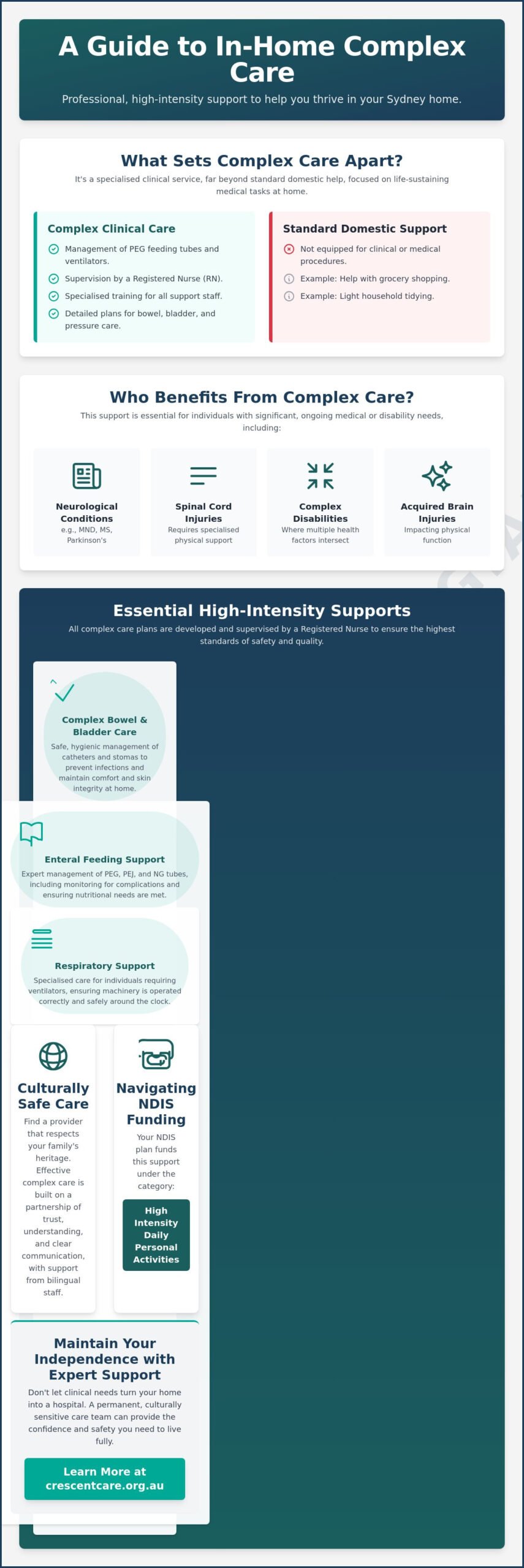
In-home complex care is a specialised form of support designed for individuals living with significant, ongoing medical or disability needs. It goes far beyond the scope of traditional domestic assistance. While standard support might involve help with the weekly grocery shop or light tidying, in home complex care sydney focuses on life-sustaining clinical tasks. This type of care is tailored for those who require a high level of skill and precision to manage their health safely within their own four walls. It’s about ensuring that a person’s medical requirements don’t define their entire existence, but rather become a managed part of a full, vibrant life.
This level of support is typically essential for individuals living with:
- Neurological conditions: Such as Motor Neurone Disease (MND), Multiple Sclerosis (MS), or advanced Parkinson’s.
- Spinal cord injuries: Requiring specialised physical support and pressure care.
- Complex physical disabilities: Where multiple health factors intersect, needing constant clinical oversight.
- Acquired brain injuries: That may impact physical function and require specialised daily monitoring.
The Shift from Hospital to Home-Based Support
Many Sydney families are choosing to move away from institutional settings in favour of home-based support. It’s a choice rooted in the desire for a better quality of life and a sense of belonging. Within the Australian healthcare system, the NDIS plays a pivotal role by funding “High Intensity Daily Personal Activities.” This framework allows participants to receive essential medical support while maintaining their dignity and agency. Being at home means you’re surrounded by your own things, your own memories, and your own community, which is often the best medicine for emotional well-being.
Signs Your Loved One Requires Complex Care
Identifying the moment when standard care is no longer enough can be difficult for families. Often, the first sign is the requirement for specialised equipment, such as ventilators or enteral feeding (PEG) tubes, which demand technical expertise to operate safely. If your loved one needs continuous monitoring or frequent clinical interventions throughout the day and night, standard personal care likely won’t suffice. It’s also a matter of safety for the family. When family carers begin to feel overwhelmed by the technical demands of medical procedures, it’s a clear signal that professional clinical backup is needed to ensure everyone stays safe and supported.
Essential High-Intensity Supports for Sydney Residents
High-intensity support is a technical field that requires more than just a helping hand. It demands a clinical eye. In the context of in home complex care sydney, this means having a Registered Nurse (RN) oversee every aspect of a participant’s care plan. RNs don’t just fill out paperwork; they provide the essential supervision and training that support workers need to perform complex tasks safely. This structure aligns perfectly with the goals of Australia’s National Disability Strategy, which focuses on empowering individuals to live safely and independently within their communities.
Specialised training is the bridge between a clinical requirement and a safe home environment. When a support worker is trained specifically for your needs, it reduces anxiety for everyone involved. This training ensures that high-intensity daily personal activities are performed with precision, whether that involves managing complex medication regimes or operating life-sustaining machinery. It’s a collaborative effort where the care team, the participant, and their family work as one.
Complex Bowel and Bladder Management
Managing catheters or stomas at home requires strict adherence to clinical protocols to prevent infections and discomfort. For many Sydney residents, having a professional team manage these needs means fewer emergency trips to the hospital. A dedicated care team ensures that skin integrity is monitored and that all equipment is handled with the highest level of hygiene. These individualised plans are designed to fit into your life, not the other way around, allowing for a routine that feels stable and predictable.
Enteral Feeding and Respiratory Support
Safe management of PEG, PEJ, or NG feeding tubes is a cornerstone of high-intensity support. It’s about more than just the feeding itself; it’s about monitoring for complications and ensuring the site remains healthy. Similarly, respiratory support, including ventilator and tracheostomy care, requires support workers who have undergone rigorous, task-specific training. This level of in home complex care sydney provides peace of mind, knowing that if a seizure occurs or equipment fails, there is a clear, practised emergency response plan in place. If you’re looking for a team that prioritises this level of clinical safety, you might consider how specialised high-intensity support can transform your daily experience.
Beyond the clinical tasks, these supports work best when integrated with allied health therapies. Whether it’s a physiotherapist assisting with chest clears or an occupational therapist adjusting specialised seating, the care team acts as the glue that holds these various therapies together. This collaborative approach ensures that your daily routine isn’t just about medical maintenance, but about active progress toward your personal goals. By focusing on specialised training and RN oversight, we create an environment where safety and independence can coexist.
Finding a Culturally Safe Complex Care Provider
Cultural safety is a non-negotiable element of high-quality support. It goes beyond simple politeness; it’s about creating an environment where you feel seen, understood, and respected in your own home. When seeking in home complex care sydney, families often prioritise clinical skills, but cultural alignment is just as vital for long-term success. A provider who understands your background can offer support that feels like a natural extension of your family life rather than an intrusion.
For Arabic-speaking families in Sydney, the benefit of bilingual support workers cannot be overstated. Being able to explain a subtle change in symptoms or a personal preference in your first language removes a significant layer of stress. It ensures that the care provided is not just medically sound but also emotionally supportive. This level of understanding extends to respecting religious and traditional practices, such as observing prayer times or following specific dietary requirements. A truly person-centred provider will weave these traditions into your daily care routine without hesitation.
Evaluating a provider’s experience with Culturally and Linguistically Diverse (CALD) communities is essential. You want a team that doesn’t just tick a box but has a deep-rooted history of serving Sydney’s diverse suburbs. Choosing a provider who understands the nuances of in home complex care sydney means finding a team that respects your traditions as much as your medical needs.
The Importance of Language in Clinical Care
Communication is the foundation of safety in a clinical setting. When medical needs are discussed in a participant’s first language, anxiety levels drop significantly. It allows for genuine informed consent, ensuring that you and your family fully understand every procedure and every change to the care plan. This clear, culturally appropriate dialogue helps bridge the gap between the complex Sydney healthcare system and the sanctuary of your home. It empowers you to be an active participant in your own health journey.
Questions to Ask Your Potential Provider
Finding the right fit requires asking the right questions. We suggest starting with these to gauge a provider’s commitment to cultural safety and clinical excellence:
- Do you have staff who speak our language or understand our specific cultural traditions?
- How do you train your team to meet high-intensity NDIS standards while remaining culturally sensitive?
- Can you help us navigate the NDIS if we are new to Australia or if English is our second language?
These questions help ensure that your care team is not just a group of professionals, but a reliable circle of support that values your heritage as much as your health.
Navigating the NDIS for High-Needs Care
The NDIS is a powerful tool for independence, but it’s rarely simple to master when your needs are technical and ongoing. For those requiring in home complex care sydney, the process starts with understanding the “High Intensity Support” category. This isn’t just a label; it’s a specific funding allocation that recognises the increased skill level your care team needs to keep you safe. Whether it’s managing a tracheostomy or complex bowel care, your plan must reflect the clinical reality of your daily life to ensure you have the right people by your side.
Advocating for the right level of funding is a journey of persistence. Following the NDIS Pricing Arrangements and Price Limits (PAPL) 2025-26 updates, which became effective on 24 November 2025, it’s vital to ensure your budget accounts for recent indexation adjustments. These changes are designed to help you maintain a stable, high-quality care team. A Support Coordinator is your best ally here. They act as the bridge, connecting you to complex care specialists and helping you piece together different funding blocks so you don’t have to carry the administrative burden alone.
It’s also helpful to distinguish between Specialist Disability Accommodation (SDA) and in-home support. While SDA refers to the physical house or building designed for high needs, your in-home support hours cover the person-to-person clinical care that happens inside it. You can often choose to receive high-intensity care in your own existing home rather than moving into a facility. This allows you to stay in the community you love while still receiving the level of medical backing you require.
Navigating the NDIS as a Newly Arrived Migrant or Refugee
Applying for the NDIS for the first time can feel like learning a new language. For newly arrived migrants and refugees in Sydney, the bureaucratic jargon and complex application forms are often significant hurdles. Local organisations can act as a compassionate guide, helping you translate your specific medical needs into the terms the NDIA requires. It’s about making sure no family is left behind because of a language gap or a “first-time” hurdle. You deserve access to essential services without getting lost in the system.
Preparing for Your NDIS Plan Meeting
Success in a plan meeting comes down to the quality of your evidence. You’ll need solid clinical reports from your specialists and Registered Nurses to justify the need for in home complex care sydney. This documentation should clearly link your medical requirements to your personal goals, such as community social inclusion or maintaining your independence. Be specific about the hours you need, especially for overnight support or complex morning routines. When you approach the meeting with clear goals and strong evidence, you’re much more likely to secure a plan that truly supports your lifestyle. To get started on building a care team that fits your NDIS goals, you can explore our high intensity support options tailored for Sydney families.
Crescent Care: Specialist Complex Support in South Western Sydney
Choosing a provider for in home complex care sydney is a deeply personal decision that goes beyond matching clinical skills. At Crescent Care, we’ve built our service on the belief that medical expertise should always be paired with a profound sense of empathy. We don’t just see a list of clinical requirements; we see a person with unique goals, a family with rich traditions, and a life that deserves to be lived with absolute dignity. Our team is deeply rooted in the local community, which allows us to provide a level of care that feels familiar, safe, and reliable.
Our specialist focus on Liverpool, Bankstown, and the surrounding suburbs means we understand the specific healthcare landscape of South Western Sydney. We recognise that for many Arabic-speaking and CALD families, finding a care team that speaks their language is just as vital as finding a team that can manage a ventilator or PEG feeding. We take pride in building bespoke care teams that reflect your heritage, ensuring that every interaction is respectful and culturally safe. This commitment to inclusivity is at the heart of everything we do, empowering your family to navigate the NDIS journey with confidence.
A Partnership Built on Trust and Empathy
We treat every participant like a member of our own community because, quite simply, you are. The Crescent Care difference lies in how we balance clinical excellence with a warm, approachable heart. While our Registered Nurses ensure your high-intensity disability supports are delivered to the highest Australian standards, our support workers provide the human connection that makes a home feel like a sanctuary. This local expertise ensures you aren’t just another number in a bureaucratic system, but a valued partner in a shared journey toward independence and growth.
Getting Started with Your Bespoke Care Plan
The path to a fully organised care team begins with a simple, pressure-free conversation. We take the time to listen to your needs, your concerns, and your aspirations before matching you with the right support workers and Registered Nurses. This isn’t a one-size-fits-all approach; it’s a careful process of finding professionals who align with your personality and your clinical requirements. From that first chat to the final implementation of your care plan, we’re with you every step of the way to ensure a seamless, supportive transition. You can enquire about our in-home complex care services today and discover how we can support your family’s unique journey with dignity and care.
Empowering Your Journey Toward Independent Living
Living with high-intensity needs shouldn’t mean sacrificing the comfort and culture of your own home. Your home remains your sanctuary. Professional clinical oversight ensures safety for technical procedures, while a culturally sensitive approach respects your family’s heritage. Finding the right in home complex care sydney can feel like a climb, but with the latest NDIS pricing updates and a clear advocacy plan, the high-quality support you deserve is within reach.
Crescent Care is an NDIS-registered provider specialising in high-intensity supports, deeply rooted in the South Western Sydney CALD community. We provide person-centred care led by experienced Registered Nurses who understand that your dignity and agency come first. If you’re ready to move beyond hospital-style living and embrace a bespoke care team that truly understands your world, we’re ready to listen.
Book a compassionate consultation with our Sydney complex care team to start building a future where you don’t just manage your health, you thrive within your own community. Your independence is our priority, and we’re honoured to walk this path beside you.
Frequently Asked Questions
What exactly is considered “high intensity” under the NDIS?
High intensity refers to supports where a participant requires assistance from a support worker with specialised skills and technical training. This usually involves clinical tasks such as tracheostomy management, catheter care, or complex wound management. The NDIS Quality and Safeguards Commission provides strict skills descriptors for these activities to ensure every procedure is performed safely and correctly.
Can I get 24/7 complex care at home in Sydney?
Yes, round-the-clock care is available at home for individuals with significant medical or disability needs. This is typically funded through NDIS core supports under High Intensity Daily Personal Activities. We help you build a stable, permanent team of workers to provide 24/7 coverage, ensuring you can remain in your own home rather than moving into a facility.
Do you provide Arabic-speaking support workers for complex care?
Absolutely, we specialise in matching Arabic-speaking support workers with families who feel more comfortable communicating in their first language. This ensures that technical clinical instructions and daily personal preferences are understood perfectly. It is a core part of our commitment to providing culturally safe in home complex care sydney that respects your heritage.
What is the difference between a Registered Nurse and a support worker in complex care?
A Registered Nurse (RN) provides clinical oversight, develops your care plan, and trains support workers in technical tasks. The support worker carries out the daily high-intensity activities under the RN’s ongoing guidance. This structure ensures that your daily care is performed by someone you know and trust, while always having professional clinical backup available.
How does the NDIS fund complex bowel or enteral feeding care?
The NDIS funds these technical tasks under the “High Intensity Support” category of your Core Supports budget. Funding is allocated based on the level of skill and time required to perform the task safely. You will need clinical evidence from a specialist to ensure your plan includes enough hours for safe in home complex care sydney delivery.
Does Crescent Care help with NDIS navigation for refugees?
Yes, we act as a compassionate guide for refugees and newly arrived migrants who find the NDIS application process overwhelming. We help translate your medical needs into the specific language the NDIA requires. Our goal is to ensure that bureaucratic hurdles or language barriers don’t prevent your family from accessing essential high-needs support.
Is complex care available in Western Sydney suburbs like Liverpool and Bankstown?
Yes, we have a specialist focus on South Western Sydney, including Liverpool, Bankstown, and all surrounding suburbs. We are deeply rooted in these local communities. Our local presence means we can build care teams that understand the unique character of your neighbourhood and provide a reliable, constant presence in your life.
What happens if my care needs change suddenly?
If your health or circumstances change, we work closely with you to adjust your care plan and advocate for an NDIS plan reassessment if required. We understand that health journeys aren’t always predictable. Our team remains flexible and responsive, ensuring your support evolves alongside your needs so you always feel secure and supported.