
What if the most vital part of your loved one’s medical care isn’t the clinical procedure itself, but the language and culture in which it’s delivered? For many families in Sydney, searching for ndis high intensity supports is about much more than ticking boxes on a care plan. You’re likely feeling the weight of ensuring medical safety while fearing that a lack of cultural understanding might lead to poor outcomes or miscommunication. It’s a stressful journey, and you deserve a partner who understands that clinical excellence and cultural respect are two sides of the same coin.
We’ve put this guide together to help you choose a provider that offers the high level of clinical expertise you need without sacrificing the warmth of a personal connection. You’ll learn how to identify NDIS-registered providers who prioritise clinical safety and offer culturally safe care, including Arabic-speaking staff in South Western Sydney. We’ll explore the benchmarks for reliable nursing and the steps you can take to ensure your loved one receives support that is as technically proficient as it is compassionate.
Key Takeaways
- Understand the specific NDIS Practice Standards that differentiate high-intensity care from standard support to ensure your loved one gets the right level of oversight.
- Learn how to verify a provider’s clinical governance and the vital role Registered Nurses play in managing complex medical risks every day.
- Discover how ndis high intensity supports can safely facilitate specialised home-based care for enteral feeding, tracheostomy, and ventilator requirements.
- Explore why cultural safety is a non-negotiable part of clinical success, particularly for Arabic-speaking families seeking a deeper connection with their care team.
- Find out how to streamline your transition to a new provider and make the most of your next NDIS plan review in the Liverpool or Campbelltown areas.
What are NDIS High Intensity Supports? Defining Complex Care
When you or a family member requires care that moves beyond help with basic daily tasks, you’re likely looking at complex care. Within the National Disability Insurance Scheme (NDIS), ndis high intensity supports are specifically designed for participants with significant, high-risk medical needs. This level of support isn’t just about providing more hours of care; it’s about the specialised skills required to manage health conditions that carry a higher risk of complications if not handled correctly.
The Difference Between Standard and High Intensity Daily Personal Activities
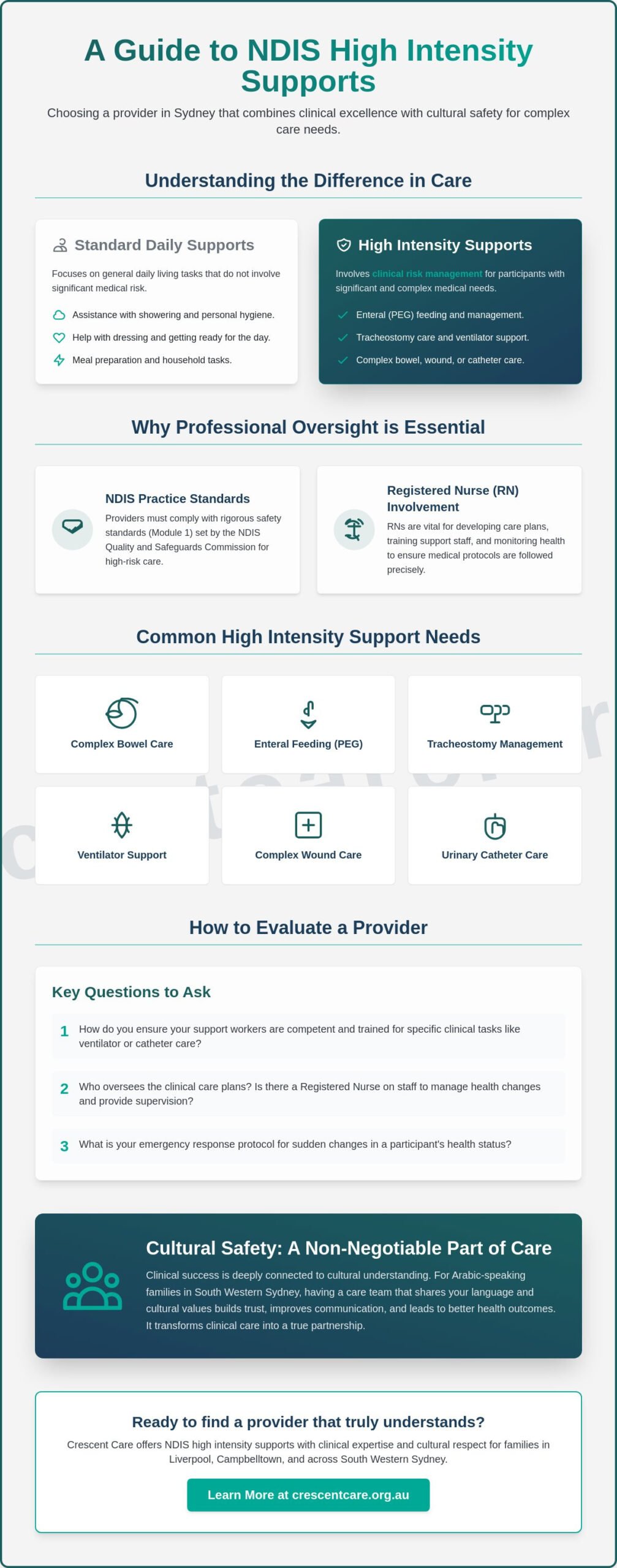
Standard care usually focuses on general daily living, such as assistance with showering, dressing, or meal preparation. While these are essential, they don’t carry the same clinical weight as high-intensity tasks. The shift to “high intensity” occurs when the support involves clinical risk management. For instance, helping someone with a meal is standard, but managing enteral feeding via a PEG tube is a high-intensity activity. Your NDIS plan might specifically allocate funding for these supports at a higher rate. This is because the NDIA recognises that the workers providing this care need advanced training and often require regular supervision by health professionals to ensure safety.
Common activities that fall under this category include:
- Complex bowel care and management.
- Enteral (naso-gastric or PEG) feeding.
- Tracheostomy management.
- Ventilator support.
- Complex wound care and urinary catheter management.
Why Professional Oversight is Essential for Complex Needs
Safety is the number one priority. The NDIS Quality and Safeguards Commission sets rigorous safety standards that providers must meet. For complex health requirements, a general support worker isn’t enough. These supports must be delivered by providers who comply with the NDIS Supplementary Module 1, which focuses on High Intensity Daily Personal Activities. This often involves Registered Nurse (RN) involvement to develop care plans, train staff, and monitor your health status. It’s a collaborative approach that ensures medical protocols are followed to the letter, giving your family the confidence that your loved one is in safe hands. To learn more about the broader range of available help, you can explore our Pillar Article on Disability Support Services for a complete overview of the system.
A Buying Guide: How to Evaluate NDIS High Intensity Support Providers
Choosing a partner for ndis high intensity supports is a deeply personal decision that goes far beyond a simple service agreement. It’s about finding a team that respects your home and your dignity while managing complex health risks with absolute precision. When you’re looking for a provider in Sydney, the first step is to verify they’re registered for High Intensity Daily Personal Activities (HIDPA). This registration isn’t just a formality; it means they’ve been audited against the NDIS Practice Standards specifically designed for high-risk care.
Clinical governance is the backbone of safe support. Don’t hesitate to ask a provider about the role of Registered Nurses (RNs) in their organisation. An RN should be responsible for creating and reviewing care plans, as well as signing off on the competency of the support workers who visit your home. This oversight ensures that medical protocols aren’t just words on a page, but are followed correctly every single day. If you’re feeling overwhelmed by the technical details, reaching out for a chat about your specific high intensity support needs can help clear the fog and provide a supportive path forward.
5 Questions to Ask a Potential Provider in Sydney
When you meet with a potential provider, use these questions to gauge their expertise and commitment to your family’s well-being:
- How do you ensure your workers are competent in specific tasks like ventilator or catheter care?
- Who oversees the clinical care plans, and is there an RN on staff to manage health changes?
- How do you handle emergencies or sudden changes in a participant’s health status?
- Can you provide support that aligns with our specific cultural and linguistic needs, such as Arabic-speaking staff?
- Can you show evidence that your training meets the NDIS High Intensity Support Skills Descriptors?
Red Flags to Avoid in Complex Disability Care
Your intuition is a powerful tool. If a provider cannot clearly explain their infection control or medication management protocols, it’s a sign they may lack the necessary clinical rigour. A lack of individualised care plans is another major warning sign; complex care can never be “one size fits all.” Be wary of organisations with extremely high staff turnover or workers who seem unfamiliar with the specific medical equipment your loved one relies on. Reliability and consistency are the foundations of safety in high-intensity settings, and you deserve a team that remains a stable, knowledgeable presence in your life.
Specialised Clinical Care: Navigating Complex Health Requirements
When we talk about ndis high intensity supports, we’re discussing life-sustaining care that requires a high level of technical precision. For many families, the transition from a hospital setting to home-based care can feel daunting. Specialised clinical support ensures that complex medical procedures are managed safely in the comfort of your own living room. This includes enteral feeding management, where naso-gastric or PEG tubes must be handled with care to prevent blockages or aspiration. It’s not just about the feeding process itself, but the meticulous hygiene and skin care that go along with it.
Other critical areas of specialised care include:
- Tracheostomy and Ventilator Support: Managing a clear airway and monitoring equipment alerts requires staff who are specifically trained in suctioning and emergency response.
- Severe Dysphagia Management: For those with significant swallowing difficulties, a detailed mealtime support plan is essential to reduce the risk of choking or chest infections.
- Complex Bowel and Catheter Care: These procedures require strict adherence to infection control protocols to maintain long-term health and comfort.
The Role of Registered Nurses in High Intensity Support
Registered Nurses (RNs) act as the clinical architects of your care team. They don’t just step in during a crisis; they are responsible for developing and reviewing the complex care plans that guide every interaction. At Crescent Care, our RNs lead the training for support workers, ensuring they are competent in the task-specific skills required for ndis high intensity supports. This clinical leadership allows us to manage risks effectively within South Western Sydney homes, providing a bridge between hospital-grade safety and the warmth of community-based living.
Individualised Care Plans: The Roadmap to Safety
A one-size-fits-all approach simply doesn’t work for complex health needs. Every participant requires a bespoke plan that reflects their specific medical condition, daily routine, and personal goals. These plans aren’t static; they need regular reviews to adapt as health requirements change over time. By keeping the care plan updated, we ensure that every worker who enters your home knows exactly what needs to be done and how to do it safely. A Person-Centred Care Plan is a dedicated clinical tool that balances your essential medical protocols with your unique lifestyle and personal dignity to ensure a high quality of life.
Cultural Safety: High Intensity Support for Arabic-Speaking Families
For many in Sydney’s vibrant Culturally and Linguistically Diverse (CALD) communities, finding ndis high intensity supports that feel “right” involves more than just checking medical qualifications. In suburbs like Liverpool, Bankstown, and Parramatta, families often face a double hurdle. You must manage complex health needs while overcoming language barriers that can make clinical instructions feel distant or confusing. We believe that cultural safety is just as vital as clinical safety. When a family feels truly understood, it creates a sense of security that allows for better health outcomes and a more peaceful home life.
Crescent Care bridges this gap by providing bilingual staff and culturally aware Registered Nurses who understand the nuances of your community. We don’t just provide medical care; we provide a partnership based on mutual respect and shared understanding. This is especially important for families in South Western Sydney who are navigating the complexities of the NDIS for the first time. We’re here to ensure that your heritage is respected while your ndis high intensity supports are delivered with the highest professional standards.
Navigating the NDIS in Your Preferred Language
It’s one thing to understand a medical procedure, but it’s another to discuss it in your mother tongue. Having support workers who can communicate medical needs in Arabic transforms the experience for everyone involved. It reduces the persistent anxiety that something might be “lost in translation” during a critical moment. When a participant and their family can speak freely with their care team, it builds a foundation of trust that is essential for long-term health. If you’re also looking into housing options, our Arabic Speaking SIL Provider Sydney guide offers more detail on culturally safe living arrangements.
Respecting Tradition While Maintaining Clinical Standards
Complex care often involves very personal and invasive procedures. We ensure that every high-intensity activity, from wound care to catheter management, is performed with the utmost modesty and respect for your family’s values. Whether it’s coordinating care around prayer times or ensuring specific dietary considerations are met during enteral feeding, we adapt our clinical protocols to fit your life. Crescent Care is committed to being a steadfast ally for newly arrived migrants and refugees, helping you feel at home in a system that can sometimes feel overwhelming. If you’re ready to partner with a team that truly speaks your language, reach out to us at Crescent Care today to discuss your family’s unique needs.
Getting Started with Crescent Care in South Western Sydney
Transitioning to a new provider for ndis high intensity supports shouldn’t feel like another hurdle to clear. It’s often the beginning of a more secure and supported chapter for your family. At Crescent Care, we’ve refined our process to make this change as smooth as possible. We start by listening to your story, understanding your medical requirements, and identifying the cultural values that make your home unique. Whether you’re in Liverpool or Campbelltown, our team is here to assist you through your first NDIS plan review, ensuring your funding accurately reflects the level of complex care you truly need.
Our “Crescent Approach” is built on the belief that clinical excellence and community heart must work together. We don’t just see a list of medical tasks; we see a person who deserves to live with dignity and joy. By combining the expertise of our Registered Nurses with the warmth of our bilingual support workers, we create a partnership that empowers you to focus on what matters most: your family’s well-being. We’re here to be a steady, knowledgeable ally as you navigate the complexities of ndis high intensity supports.
Our Service Area: Local Support Across Sydney
We’re deeply rooted in the South Western Sydney community, with a strong presence in local hubs like Liverpool, Bankstown, and Parramatta. Our team understands the local landscape and the specific needs of families living in these vibrant areas. As Sydney grows, so do we. We’re proud to provide dedicated in-home support in developing suburbs like Rossmore and Austral, ensuring that high-quality care is accessible no matter where you call home. Our focus remains on being a reliable, local presence for those who need us most.
Take the Next Step Toward Quality Complex Care
If your current care isn’t meeting the standards your family deserves, it’s important to know that you have the power to make a change. Switching providers is a straightforward process, and we can guide you through every step to ensure there’s no gap in your support. We invite you to reach out for a no-obligation discussion about your complex care requirements. It’s an opportunity to ask questions, meet our team, and see how our approach fits your lifestyle. Contact the Crescent Care team today to organise your high-intensity support and discover the peace of mind that comes with professional, compassionate care.
Building a Foundation of Safety and Belonging
Choosing the right path for your loved one’s care is a decision that shapes your daily life and your family’s peace of mind. We’ve explored how ndis high intensity supports provide much more than just a list of medical tasks; they offer a foundation of security through rigorous clinical protocols and consistent Registered Nurse oversight. By prioritising both clinical excellence and cultural respect, you ensure that every procedure is handled with professional skill and a deep understanding of your family’s unique heritage.
Crescent Care is NDIS-registered for complex care, offering the expertise of Arabic-speaking clinical staff who bridge the gap between technical requirements and heartfelt communication. Our Registered Nurses personally oversee all high-intensity plans, ensuring that safety standards are met with compassion every day. You don’t have to manage these complexities alone when a dedicated partner is ready to walk beside you. Secure your family’s future with Crescent Care’s high intensity support today.
We’re here to help you move forward with confidence, knowing that your loved one is supported by a team that values their dignity as much as their health. Your journey toward better, safer care starts with a simple conversation.
Frequently Asked Questions
What qualifies as ‘high intensity’ under the NDIS?
High-intensity supports refer to care for participants who have significant health risks or complex medical requirements. This includes tasks like managing a tracheostomy, complex wound care, or providing enteral feeding. The NDIS categorises these as High Intensity Daily Personal Activities (HIDPA) because they require a higher level of skill and clinical oversight to ensure the participant’s safety and well-being every day.
Can any support worker provide high intensity supports?
No, only workers who have undergone task-specific training and been assessed as competent can provide these services. Every worker must meet the requirements outlined in the NDIS High Intensity Support Skills Descriptors. This ensures they have the practical knowledge to handle medical equipment and follow clinical protocols safely, preventing complications that could arise from standard care approaches.
Is a Registered Nurse required for all high intensity supports?
While a Registered Nurse (RN) might not be the person providing the daily support, their involvement is essential for planning and oversight. An RN is responsible for developing your clinical care plan and training support workers in specific medical tasks. This clinical governance ensures that ndis high intensity supports are delivered safely and that any changes in your health are professionally monitored.
How do I know if my NDIS plan covers high intensity supports?
You can find this information in your NDIS plan under the Core Supports budget, specifically within the “Assistance with Daily Life” category. If your plan includes funding at the “high intensity” rate, it’s a clear indication that you’ve been assessed as needing this level of specialised care. If you’re unsure, your support coordinator or a registered provider can help you interpret your plan’s specific line items.
What is the difference between complex care and high intensity support?
These terms are frequently used interchangeably, but “high intensity” is the formal NDIS terminology used for funding and practice standards. Complex care is a broader term that describes the nature of the medical needs themselves. In the NDIS system, receiving ndis high intensity supports means your provider must meet specific clinical safety modules that go beyond the requirements for standard daily assistance.
Can Crescent Care help me with high intensity support if I speak Arabic?
Yes, we specialise in providing culturally safe care for Arabic-speaking families across Sydney. We understand that discussing complex medical needs is much easier in your mother tongue, which is why we offer bilingual support workers and culturally aware nurses. This approach ensures that your family’s traditions and language are respected while maintaining the highest clinical safety standards in your home.
What happens if my medical needs change over time?
If your health requirements shift, your clinical care plan must be updated immediately by a Registered Nurse. We work closely with you to monitor these changes and can assist in gathering the evidence needed for an NDIS plan review. This proactive approach ensures your funding and support levels always match your current needs, providing a continuous safety net as your circumstances evolve.
Are high intensity supports available in Western Sydney suburbs like Liverpool?
Yes, we provide specialised care throughout South Western and Western Sydney, including suburbs like Liverpool, Bankstown, and Campbelltown. Our local presence allows us to be a reliable partner for families in these growing communities. We’re committed to making high-quality clinical support accessible to everyone in the region, ensuring you don’t have to travel far to find an expert care team that understands your area.