
Imagine standing in your Sydney lounge room, feeling the weight of the technical manuals and the constant hum of equipment, wondering if you’re truly prepared for what comes next. It’s completely natural to feel overwhelmed when you’re first managing tracheostomy care at home. The transition from a clinical hospital setting to the rhythm of family life is a massive step; the fear of an emergency or a technical glitch can sometimes feel like it’s overshadowing the simple comfort of being together. You deserve to feel like a family again, not just a team of medical monitors.
This guide will help you master the essentials of safe, home-based management while helping you navigate NDIS High Intensity Support with absolute confidence and cultural care. We’ll walk through how to build a support team that truly understands your heritage and speaks your language. We’ll also simplify your daily maintenance using the latest NSW clinical guidelines and help you set up clear emergency protocols. By the end of this article, you’ll have a clear path to organising a safe, supportive environment where your loved one can truly thrive.
Key Takeaways
- Learn how to create a safe and organised home environment that makes daily routines feel manageable rather than medical.
- Master the technical side of tracheostomy care with a clear checklist of essential supplies and hygiene protocols.
- Understand how to spot early warning signs and build a reliable emergency plan to keep your loved one safe in the community.
- Uncover the steps to securing NDIS High Intensity Support funding so you have the professional help your family requires.
- Explore the value of partnering with a support team that respects your cultural background and speaks your language.
What is Tracheostomy Care and Why is Home Support Vital?
Bringing a loved one home with a tracheostomy is a momentous occasion. It marks a shift from the rigid, sterile environment of a hospital ward to the warmth and familiarity of your own lounge room. However, we understand that this milestone often comes with a mix of relief and deep-seated anxiety. To truly grasp the scope of this journey, it helps to start with the fundamentals. What is a Tracheostomy? Essentially, it’s a surgical opening in the neck that provides a direct airway, allowing for better breathing and, in many cases, improved communication. Tracheostomy care involves the daily management of this opening and the tube itself, ensuring the airway remains clear and the surrounding skin stays healthy.
Transitioning to home isn’t just about moving locations; it’s about building a fortress of safety around your family member. This is where NDIS High Intensity Support becomes a vital bridge. Because these medical needs are complex, the NDIS provides specific funding to ensure the people helping you are highly trained and capable of managing technical equipment. You aren’t just “getting by” at home. You’re creating a professional-grade care environment where your loved one can flourish. We recognise the emotional weight you carry as a family member taking on this responsibility. It’s a role that requires immense courage and dedication.
The Goal of Home-Based Management
The primary aim of home-based management is to maintain airway patency while preventing infections in a comfortable setting. By staying in a familiar environment, participants often experience lower stress levels, which can lead to better long-term health outcomes. Consistent, high-quality tracheostomy care reduces the risk of complications that lead to hospital readmissions. Beyond the clinical side, being at home promotes genuine independence and allows for community participation that simply isn’t possible in a hospital setting.
Who Provides Tracheostomy Support in Sydney?
In Sydney, this support is a collaborative effort. Registered Nurses often oversee the complex clinical aspects, while specially trained support workers assist with daily routines. We believe in empowering family members too. Through hands-on training and advocacy, you become the most vital part of the care team. For families in diverse areas like Liverpool and Bankstown, cultural safety is just as important as clinical safety. Having a team that understands your heritage and speaks your language ensures that care is respectful, dignified, and truly person-centred. It’s about finding a partnership that feels like family, backed by professional expertise.
The Essential Home Tracheostomy Kit & Daily Routine
Organising your home for tracheostomy care doesn’t require you to sacrifice the warmth of your living space. While a hospital ward is designed for clinical efficiency, your home is designed for living. The key to successful home-based care is creating a dedicated station that blends into your daily environment. Choose a well-lit area with a clean, flat surface to organise your supplies. Using clear, labelled tubs helps everyone in the family, or any visiting support workers, find exactly what they need without a fuss. It’s about creating a sense of order that reduces stress for everyone involved.
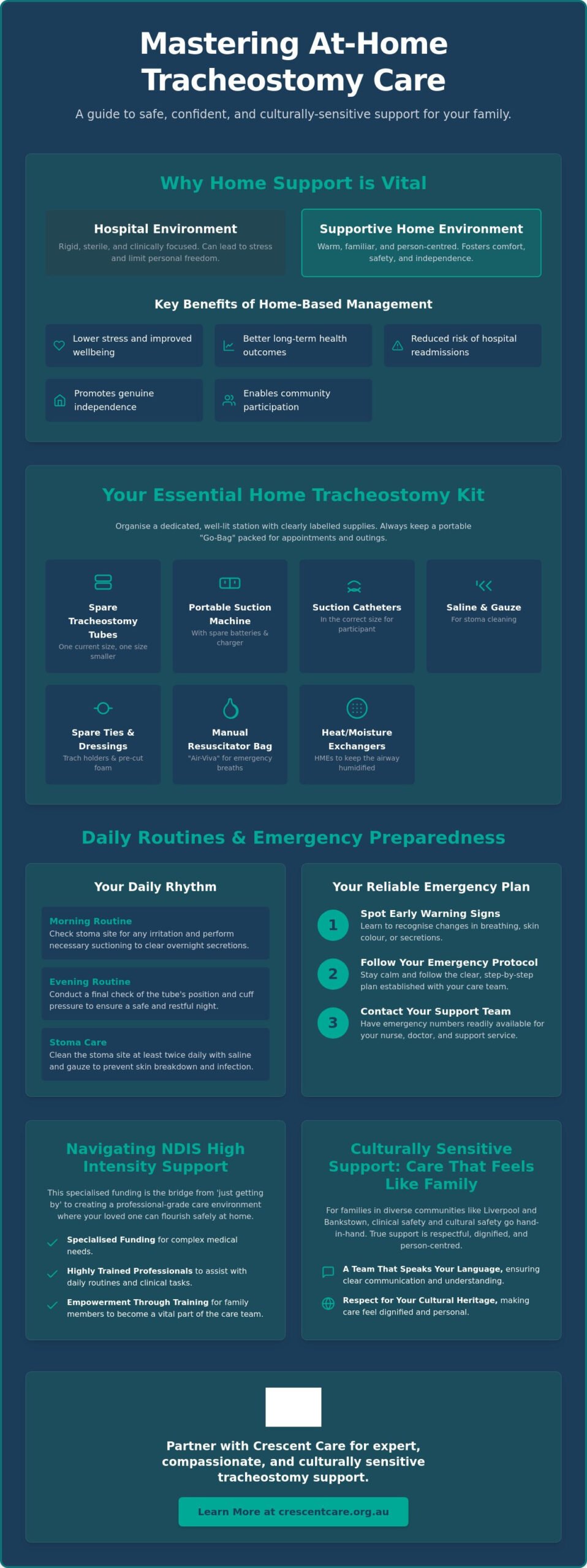
An essential home kit should always be ready and fully stocked. We recommend keeping a “Go-Bag” packed as well, which is a portable version of your home station for trips to the local park or appointments. Your home kit should include:
- Spare tracheostomy tubes (one of the current size and one a size smaller).
- A portable suction machine with spare batteries and chargers.
- Suction catheters in the correct size for the participant.
- Sterile saline ampoules and clean gauze for stoma cleaning.
- Spare tracheostomy ties or holders and pre-cut foam dressings.
- A manual resuscitator bag (often called an Air-Viva) for emergency breaths.
- Heat and Moisture Exchangers (HMEs) to keep the airway humidified.
Establishing a predictable morning and evening rhythm provides comfort. Start your day by checking the stoma site and performing any necessary suctioning to clear secretions that may have accumulated overnight. In the evening, a final check of the tube’s position and cuff pressure helps ensure a restful night. If you’re ever feeling unsure about these technical steps, our team provides High Intensity Support to guide you through these routines until they feel like second nature.
Daily Maintenance and Stoma Care
Clean the stoma site at least twice daily using saline and gauze to prevent skin breakdown. It’s a gentle process that protects against infection and keeps the area comfortable. When you’re changing the ties, always ensure the tube is held securely by a second person to prevent accidental displacement. This is the perfect time to check the skin for any new redness or irritation that might need attention.
Suctioning Techniques: When and How
You’ll soon learn to recognise the subtle signs that suctioning is required. This might include a bubbly or “rattling” sound in the tube, a frequent cough, or your loved one appearing slightly restless. Always use a clean technique to protect the participant’s health. Insert the catheter gently without applying suction; only apply the suction as you slowly withdraw the catheter in a steady motion. Keep the process brief to ensure it’s as comfortable as possible for your family member.
Safety and Emergency Preparedness in the Community
We understand that even with the best daily routine, the thought of something going wrong can be a source of quiet worry. However, true confidence in tracheostomy care comes from knowing exactly how to respond when the unexpected happens. Safety isn’t just about what you do at the bedside; it’s about being prepared for life in the community, whether you’re at the local shops or visiting family. By learning to spot the early warning signs of a blocked or displaced tube, you can act before a situation becomes critical.
Early signs often include a change in the sound of breathing, such as a high-pitched whistle or a rattle that doesn’t clear with suctioning. You might notice your loved one appearing more anxious, restless, or using extra effort to breathe. If you see any of these “Red Flags,” it is time to follow your clinical plan or contact your GP. If their skin colour changes or they become unresponsive, call 000 immediately. Keeping a list of local emergency contacts, including your NDIS provider and the nearest hospital with an ENT department, on the fridge and in your Go-Bag ensures you never have to search for numbers in a hurry.
Equipment reliability is your safety net. Ensure your suction machine is serviced regularly and always check that your battery backups are fully charged before leaving the house. In a bustling city like Sydney, power outages or travel delays can happen; having that extra power provides essential peace of mind. Regular maintenance of your equipment is just as important as the care of the stoma itself.
Troubleshooting Common Issues
Managing thick secretions or minor bleeding at the stoma site can often be handled with increased humidification or gentle cleaning. However, if the tube is accidentally dislodged, you must stay calm and follow your emergency reinsertion training. Accidental decannulation is when the tracheostomy tube comes out of the stoma unexpectedly, and it is a medical emergency that requires immediate action to restore the airway.
Your Emergency Action Plan
Always keep two spare tubes within arm’s reach: one the same size and one a size smaller. The smaller tube is easier to insert if the stoma begins to close during an emergency. It’s also vital to train every household member on basic response steps so you aren’t the only one who knows what to do. Finally, ensure your house number in Liverpool or Campbelltown is clearly visible from the street so emergency services can find you without delay if you ever need to call 000.
Navigating NDIS Funding for High Intensity Care
Securing the right funding for tracheostomy care shouldn’t feel like an uphill battle while you’re already managing complex health needs. The NDIS recognises that certain supports require a higher level of skill and safety. Because of this, it classifies this type of assistance under the High Intensity Daily Personal Activities category. This classification is vital because it ensures your budget reflects the need for support workers who have received specific training or oversight from a Registered Nurse. It’s about making sure the person coming into your home is fully equipped to support your family’s unique situation with confidence.
To ensure your NDIS plan includes enough hours for nursing or trained support, you’ll need to bridge the gap between clinical requirements and your personal goals. The NDIA looks for evidence that these supports are “reasonable and necessary” to help the participant live a fulfilling life at home. By clearly linking your medical needs to your desire for community participation and independence, you create a strong case for a budget that truly covers the costs of high-quality care. We’ve seen how a well-structured plan can transform a family’s experience, turning a time of stress into a journey of growth and security.
Accessing Complex Care Funding
Success starts with the right evidence. You’ll need detailed reports from specialists, such as your ENT surgeon or a clinical nurse consultant, to justify high-intensity funding. These documents should outline the frequency of suctioning, stoma care, and the level of risk involved. Once you have this evidence, you can link these care needs to the “Core Supports” section of your NDIS budget. For a deeper look at how to manage your plan effectively, you can explore our guide to disability support services in Sydney.
The Value of Support Coordination
A Support Coordinator acts as your dedicated advocate in the complex NDIS landscape. In areas like South Western Sydney, they play a crucial role in finding NDIS-registered nurses and providers who truly understand tracheostomy care. They don’t just find any provider; they help you find a team that respects your family’s cultural and linguistic preferences. As your needs evolve over time, your coordinator will help organise regular plan reviews to ensure your funding remains sufficient. If you need help navigating these categories or finding the right staff for your home, feel free to reach out to our friendly team for a chat about your options.
Partnering with Crescent Care for Culturally Sensitive Support
Choosing a provider for tracheostomy care is a deeply personal decision that goes far beyond checking off a list of clinical skills. You aren’t just looking for someone to manage equipment; you’re looking for a person who fits into the rhythm of your family’s life. At Crescent Care, we prioritise the individual before the process. Our approach is rooted in the belief that every person deserves to live with dignity and agency, regardless of their medical needs. We see ourselves as your dedicated partners, working alongside you to ensure your home remains a place of comfort, growth, and genuine connection.
For many families across Sydney, especially within our vibrant CALD communities, language and heritage are vital parts of the healing process. We know how much it matters to have a support worker who understands your traditions and can speak your language, such as our Arabic-speaking staff members. This cultural safety is a core part of our mission. It allows for clearer communication during daily routines and provides a sense of security that a purely clinical approach often lacks. We’re proud to serve the diverse families of Liverpool and surrounding suburbs, ensuring that your heritage is respected and celebrated as part of your care journey.
While we lead with heart, we back our support with rigorous clinical standards. Every support worker we employ undergoes thorough training to meet the highest Australian benchmarks for high-intensity support. This ensures that when they step into your home, they are fully prepared to manage technical equipment and follow precise safety protocols. We aim to bridge the gap between the hospital and the home, making the transition as smooth as possible so you can focus on the joy of being together again. We lead the way in training our staff to be both technically proficient and deeply empathetic.
High-Intensity Care with a Human Touch
Matching participants with the right carers is about finding a personality match that fosters long-term trust. Our commitment to social inclusion means we don’t just focus on the tube or the suction machine; we focus on helping your loved one participate in the activities they love. Whether it’s attending a family gathering or enjoying a quiet afternoon in the garden, we facilitate those moments while maintaining the highest safety standards. We believe that tracheostomy care should empower a person’s life, not define it.
How to Get Started with Crescent Care
Taking that first step can feel like a big move, but we’re here to make it easy and welcoming. We invite you to start an open conversation about your family’s specific needs, your cultural preferences, and your long-term goals. With a strong local presence in Bankstown, Campbelltown, and Parramatta, we are deeply rooted in your community and ready to assist. Contact our friendly team today to discuss your tracheostomy care plan and discover how we can support your journey toward independence and peace of mind.
Embracing a Future of Confidence and Connection at Home
Transitioning to life at home with a tracheostomy is a journey of adaptation and resilience. By mastering your daily maintenance routines and building a robust emergency plan, you’ve already taken the most important steps toward long-term safety. Understanding how to align your NDIS funding with high-intensity support categories ensures that you have the professional resources needed to maintain this balance. You don’t have to carry the weight of medical management alone; the right support makes all the difference in returning to the simple joys of family life.
As an NDIS-registered provider serving South Western Sydney, we specialise in complex disability assistance that respects your unique heritage. Our team includes Arabic-speaking and CALD-specialist staff who bring a sense of belonging and cultural safety to every interaction. If you’re ready to find a partner who values your loved one’s dignity as much as their clinical safety, we’re here to help. Enquire about our High-Intensity Tracheostomy Support today to start a conversation about your family’s future. You have the strength to navigate this path, and we’d be honoured to walk it with you.
Frequently Asked Questions
What is NDIS high intensity support for tracheostomy care?
NDIS high intensity support is a specific funding category for participants with complex health needs that require a higher level of skill and safety. For tracheostomy care, this means your plan is structured to provide support workers who have received specialised training or work under the oversight of a Registered Nurse. This ensures every person assisting you has the technical competence to manage equipment safely while supporting your daily goals.
Can a support worker perform tracheostomy suctioning at home?
Yes, a support worker can perform suctioning if they have completed specific high-intensity training and have been assessed as competent by a health professional. It isn’t a standard task for all carers; it requires a deep understanding of the participant’s clinical plan and emergency protocols. We ensure our team members are fully confident in these techniques before they begin supporting your family in the home.
How do I get an NDIS-registered nurse for home care in Sydney?
You can access nursing care by ensuring your NDIS plan includes funding for “Community Nursing” or “High Intensity Daily Personal Activities.” Once your budget is approved, you can partner with an NDIS-registered provider like Crescent Care to arrange for a nurse to visit your home. We assist families across Sydney in navigating this process so that clinical oversight becomes a seamless part of your support team.
What should I do if my child’s tracheostomy tube comes out?
If a tube is accidentally dislodged, you must stay calm and immediately follow your clinical emergency plan to reinsert the spare tube or the smaller backup size. This is a medical emergency known as accidental decannulation; you should call 000 as soon as you’ve taken steps to manage the airway. Having your emergency Go-Bag within reach at all times ensures you can act quickly to restore your child’s breathing.
Are there Arabic-speaking NDIS providers for complex care in Liverpool?
Yes, Crescent Care provides culturally sensitive support with Arabic-speaking staff specifically for families in Liverpool and South Western Sydney. We recognise that complex disability support is much more effective when your team understands your language and heritage. This cultural connection helps build trust and ensures that clinical care instructions are clearly understood by everyone involved in the participant’s life.
How often does a tracheostomy tube need to be changed at home?
The frequency of tube changes depends on the specific type of tube and the clinical instructions provided by your ENT specialist. Most long-term tubes are changed every seven to thirty days to maintain hygiene and prevent skin irritation. Your Registered Nurse will work with you to establish a regular schedule that keeps the stoma healthy and ensures the equipment remains in peak condition.
Does the NDIS cover the cost of tracheostomy supplies?
Yes, the NDIS typically covers the cost of essential supplies like spare tubes, suction catheters, and gauze through the “Consumables” category within your Core Supports budget. It’s important to have these items clearly documented in your plan to ensure you always have a reliable stock on hand. We can help you identify which items are necessary so you don’t face out-of-pocket expenses for these vital health supplies.
What training is required for family members managing a tracheostomy?
Family members usually receive hands-on clinical training from hospital staff or a Registered Nurse before a loved one is discharged home. This training covers daily hygiene, suctioning techniques, and how to respond to emergencies like a blocked tube. Ongoing support and refresher sessions are also available through your high-intensity provider to ensure you always feel confident and capable in your role as a carer.