

Imagine sitting at your kitchen table, staring at a thick NDIS plan filled with bureaucratic jargon that feels completely disconnected from your daily life. You know your family needs extra support, but the thought of inviting a stranger into your sanctuary can feel more daunting than helpful. Finding the right home care ndis support shouldn’t feel like a second job or a source of constant worry. You deserve to feel heard, respected, and confident that the people entering your home truly understand your cultural values and speak your language.
We understand that this journey is deeply personal, especially with the significant legislative changes and the new framework planning model rolling out from 1 July 2026. This guide is designed to clear the fog and put the power back in your hands. You’ll learn exactly how to check your current funding levels, how to vet providers for a genuine cultural match, and what the upcoming 90-day claiming window means for your family’s budget. We are going to walk through a simple, step-by-step process to help you build a support team that feels like a natural, reliable extension of your own community.
Key Takeaways
- Discover how home care ndis focuses on your dignity and autonomy, helping you maintain independence in the comfort of your own house.
- Learn how to identify the specific funding in your NDIS plan, specifically looking for ‘Assistance with Daily Life’ under your Core Supports budget.
- Understand the value of culturally safe care and why finding a provider who respects your language and traditions is vital for your peace of mind.
- Follow our five practical steps to move from feeling overwhelmed by paperwork to having a reliable support team in place.
- Explore the benefits of choosing a local South Western Sydney provider that prioritises a person-centred approach and treats your family with genuine care.
What is NDIS Home Care and How Does it Support Independence?
At its heart, home care ndis support is about more than just checking off a list of chores. It is a collaborative partnership designed to ensure you or your loved one can remain in a familiar, comfortable environment while receiving the specific help required to thrive. The primary goal is to foster independence and preserve dignity. This means support workers don’t just “do things” for you; they work alongside you to facilitate a life that feels autonomous and meaningful. By receiving care in your own house, you maintain the choice and control that the National Disability Insurance Scheme (NDIS) was created to protect.
Understanding the difference between funding categories is essential for making the most of your plan. Most home-based supports fall under Core Supports, which provide the essential help you need for everyday activities. Choosing the right home care ndis provider means finding a team that respects your routine and your home as a sanctuary. While Core Supports handle the immediate needs, Capacity Building supports focus on the long term, helping you learn new skills so you can eventually perform tasks more independently. This balanced approach ensures you are safe today while growing stronger for tomorrow.
Assistance with Daily Life vs. Household Tasks
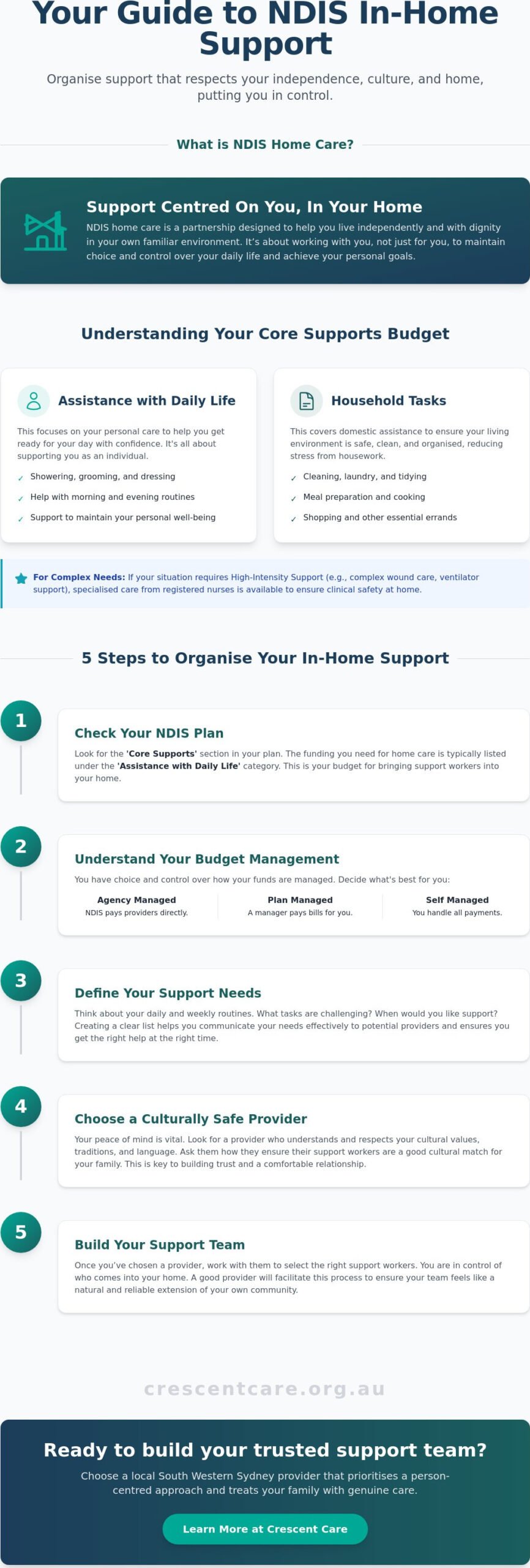
Personal care, often referred to as ‘Assistance with Daily Life’, focuses on the individual. This includes help with showering, grooming, dressing, and morning routines. It is about helping you feel your best so you can take on the day with confidence. On the other hand, domestic assistance covers ‘Household Tasks’ like cleaning, laundry, and meal preparation. These services work together to ensure your living environment is safe and organised, allowing you to live a colourful and active life without the stress of overwhelming housework. We believe these supports should always feel like a helping hand, never an intrusion.
High-Intensity Support at Home
For some families, the level of care required goes beyond basic assistance. High-intensity support is designed for participants with complex health needs that require specialised skills or medical knowledge. This might involve seizure management, complex wound care, or ventilator support. In these instances, the role of registered nurses becomes vital to ensure safety and clinical oversight. If your situation requires this level of expertise, you can find detailed information on how we manage in-home complex care Sydney. This ensures that even those with the most challenging health requirements can stay exactly where they want to be: at home with their families.
Checking Your NDIS Plan for Home and Living Funding
Finding out if you have the right funding starts with a close look at your NDIS plan. Most people feel a bit overwhelmed when they first see the pages of tables and codes, but it’s simpler than it looks once you know where to focus. You want to head straight to the section titled ‘Core Supports’. This is the flexible part of your budget that covers your daily needs. Within this category, keep an eye out for the line item ‘Assistance with Daily Life’. This is the specific funding that allows you to bring home care ndis support into your house to help with things like personal care or household tasks.
The beauty of the scheme is the principle of ‘Choice and Control’. This means you are the boss of your own life. You decide which support workers enter your home, what time they arrive, and how they help you. If you are currently Checking Your NDIS Plan for Home and Living Funding and find that these supports aren’t listed, don’t lose heart. It simply means we need to prepare for a plan review to show the NDIS why this support is reasonable and necessary for your independence. You have the right to a plan that truly reflects your daily reality.
Understanding Your Budget
NDIS funding is typically allocated on an annual basis, which means managing the pace of your spending is important. You have three main options for how this is handled. Agency Managed plans are overseen by the NDIS directly, while Self Managed plans give you total control and responsibility. Many families find the middle ground of Plan Management to be the most supportive. Plan Management is a way to have your bills paid for you by an expert, which takes the administrative burden off your shoulders while giving you the freedom to choose your own providers. This professional oversight is becoming even more crucial; from 1 December 2026, the timeframe for providers to claim for services will be reduced from two years to 90 days. If you need help understanding these categories, feel free to reach out for a friendly chat.
When to Request a Plan Review
Sometimes, life changes and your current plan no longer fits your needs. You might notice that you’re feeling more tired, your house is becoming harder to manage, or your family carers are feeling burnt out. These are clear signs that it’s time to request a plan review. To do this successfully, you’ll need to gather evidence from your GP, specialists, or current support team. The NDIS is also transitioning to a ‘new framework planning’ model from 1 July 2026, which will involve a new support needs assessment process. For newly arrived migrants and refugees, this process can be especially daunting due to language barriers. Advocacy is vital here; having someone by your side to help explain your cultural needs ensures you get the home care ndis funding you truly deserve.
How to Choose a Culturally Safe Home Care Provider in Sydney
Choosing a provider is about more than just finding someone with an NDIS registration. It is about finding a team that honours your traditions, understands your religion, and respects the way your household functions. We define culturally safe care as support that acknowledges your unique background without you ever having to explain or justify your values. When you are looking for home care ndis support, you should feel that your support workers aren’t just guests, but people who truly “get” your way of life. This level of comfort is what allows true independence to flourish.
Local knowledge is incredibly important in diverse communities like Liverpool, Bankstown, and Fairfield. A provider rooted in South Western Sydney understands the local community rhythms and the specific needs of families from various backgrounds. While the official NDIS Home and Living Supports portal is a great starting point for finding registered names, it doesn’t always show you the heart of a business. We encourage you to ask potential providers direct questions about their experience with Culturally and Linguistically Diverse (CALD) communities. A provider who values inclusivity will be happy to discuss how they match support workers to your specific cultural requirements.
The Importance of Language and Communication
Clear communication is the foundation of trust. When a participant and their family can speak their primary language with a support worker, anxiety levels drop significantly. Bilingual workers do more than just translate; they help bridge the gap between complex Australian home care ndis terminology and your daily reality. This is particularly vital for families who might be looking for more than just a few hours of help a week. For instance, if you are exploring long-term housing options, connecting with an Arabic speaking SIL provider Sydney can make the transition to independent living feel safe and familiar.
Advocacy for Refugee and Migrant Families
The Australian disability system is complex, and for those currently on a settlement journey, it can feel like an impossible maze. Some providers go the extra mile by offering specialized advocacy to help you find your feet. You deserve a partner who understands the unique challenges faced by newly arrived migrants and refugees, from language barriers to the fear of navigating government departments. If you’re just starting out and feeling overwhelmed by the paperwork, seeking out NDIS application help for refugees Sydney can ensure you don’t miss out on the vital support your family needs to build a bright future.
5 Practical Steps to Organise Your In-Home Support
Moving from a thick NDIS plan to actual support in your lounge room is a significant milestone. It is the moment where theory becomes practice and your goals start to feel achievable. Setting up home care ndis support should be a transparent and collaborative process that leaves you feeling empowered rather than exhausted. By following a methodical path, you can ensure that the support you receive is safe, reliable, and perfectly tailored to your family’s unique rhythm. Here are the five practical steps to get your support off the ground:
- Step 1: Identify your specific needs. Sit down and map out your day. Do you need a hand with the morning rush, or is assistance with meal preparation and evening routines more valuable? Being clear about specific tasks helps you find a worker with the right skills.
- Step 2: Research local providers. Look for registered NDIS providers with a strong presence in South Western Sydney. A local provider will have a better understanding of community resources and can often offer more flexible scheduling.
- Step 3: Conduct a meet and greet. Before any work begins, invite potential support workers for a chat. This is your opportunity to see if their personality and cultural background align with your family’s values.
- Step 4: Create a Service Agreement. This is a formal document that protects your rights. It must clearly outline the services provided, the costs involved, and how either party can end the agreement if things change.
- Step 5: Start with a trial period. Don’t feel pressured to commit for a year on day one. A trial period of two to four weeks allows everyone to see if the home care ndis arrangement is working in a real-world setting.
Creating a Personalised Care Schedule
A great schedule does more than just list hours; it respects the natural flow of your household. We recommend organising shifts around your family’s existing routines, such as Friday prayers, cultural celebrations, or regular family dinners. Consistency is the key to building trust, so aim to have the same support worker visit you regularly. This allows them to learn your preferences and notice subtle changes in your well-being. A care schedule should be a living document that changes with your needs. If you’re ready to begin this journey, our team is here to help you organise your in-home support with the warmth and respect your family deserves.
Safety and Quality Checks
Your home is your sanctuary, and your safety is our absolute priority. Always verify that your chosen provider strictly follows the rules set by the NDIS Quality and Safeguards Commission. You have every right to ask about their worker screening processes, including current Police Checks and NDIS Worker Screening Checks. A reliable provider will be open and transparent about these details. They should also provide you with a clear, easy-to-follow process for giving feedback or making a complaint, ensuring that your voice is always the most important one in the room.
Why Crescent Care is the Trusted Choice for Sydney Families
Choosing a partner for your home care ndis journey is a decision that carries great weight. It is about more than just finding a service provider; it is about finding a group of people who truly care about your family’s happiness and security. At Crescent Care, our roots are planted deeply in the South Western Sydney community. We aren’t a distant, faceless corporation. We are your neighbours, your advocates, and your steadfast allies. We believe that every person deserves to live with dignity, and we work tirelessly to ensure our support feels like a natural, welcoming extension of your own home life.
Our approach is fundamentally person-centred. This means we place your goals, your cultural values, and your personal agency at the heart of everything we do. We don’t believe in “one-size-fits-all” solutions. Instead, we treat every participant like a member of our own family, listening with patience and adapting our support to fit your unique path. Whether you require help with simple daily tasks or have more complex requirements, our expertise in high-intensity disability support ensures you receive the professional, reliable care you need to stay safe and independent in the house you love.
Specialist Support in Your Neighbourhood
We are proud to have a strong, visible presence in the heart of our local communities, including Liverpool, Bankstown, Campbelltown, and Parramatta. Our team understands the vibrant, diverse tapestry of these areas, which allows us to help Culturally and Linguistically Diverse (CALD) families feel completely secure and understood. We know that navigating the system can be challenging, which is why we offer a wealth of resources, including our comprehensive disability support services guide. By choosing a provider that is local to your neighbourhood, you gain a partner who is personally invested in the well-being of the South Western Sydney community.
Taking the First Step Together
Starting this process can feel like a big leap, but you don’t have to take it alone. We are here to act as your compassionate guide, helping you cut through the bureaucratic jargon and get the absolute most from your NDIS plan. We invite you to join us for a no-obligation chat about your goals and your current funding. You’re always welcome to give us a phone call or drop by our centre to meet the team and see firsthand how we can support your independence. We believe in the power of conversation and the strength of a shared journey. Contact Crescent Care today to organise your home support and let’s start building a brighter, more autonomous future together.
Embrace Your Independence with the Right Support
Organising home care ndis support is a powerful way to reclaim your time and ensure your loved ones live with the dignity they deserve. By understanding your budget and following a clear, step-by-step setup process, you can move away from the stress of paperwork and back to what matters most: your family. Remember that you have the right to choose a team that speaks your language and honours your cultural traditions. This choice is the foundation of a safe, respectful environment where every participant can truly flourish.
As an NDIS Registered Provider and an ACNC-registered Not-For-Profit, we are here to ensure you feel seen and heard. Our team specialises in CALD and Arabic-speaking support, providing the local expertise families in South Western Sydney need to thrive. You don’t have to navigate these changes alone. We invite you to Book a Compassionate Consultation with Crescent Care so we can help you unlock the full potential of your plan. Your journey towards a more supported, colourful life starts with a simple conversation; we can’t wait to walk beside you.
Frequently Asked Questions
Can NDIS home care funding be used for gardening or home maintenance?
Yes, you can use your funding for gardening and home maintenance if your disability prevents you from performing these tasks yourself. These services are typically funded under the ‘Household Tasks’ category within your Core Supports budget. It is important to demonstrate that this support helps you maintain a safe, accessible, and healthy home environment while fostering your independence.
How do I find an Arabic-speaking NDIS support worker in Sydney?
You can find Arabic-speaking support workers by connecting with specialist providers like us who focus on culturally safe care. We prioritise matching you with workers who understand your language and traditions to make your home care ndis experience as comfortable as possible. Community centres and local advocacy groups in South Western Sydney are also excellent resources for finding bilingual support.
What is the difference between a registered and unregistered NDIS provider for home care?
Registered providers are officially audited and monitored by the NDIS Quality and Safeguards Commission to ensure they meet high safety and quality standards. Unregistered providers don’t undergo this formal audit process. While you can use unregistered providers if you are Plan Managed or Self Managed, choosing a registered provider offers an extra layer of professional accountability and protection for your family.
Can I change my home care provider if I am not happy with the service?
You have the absolute right to change your provider at any time if you aren’t satisfied with the service. The principle of Choice and Control means you are never locked into a partnership that doesn’t feel right for your household. Simply check your current Service Agreement for the required notice period, which is usually around two weeks, and then begin a new journey with a team that better suits your needs.
How much does NDIS home care cost per hour in 2026?
The cost for home care is determined by the NDIS Pricing Arrangements and Price Limits, which are updated by the government annually. For the 2025-26 period, the standard weekday daytime rate for personal care is $70.23 per hour. These rates are set to ensure fair pricing across the sector, though they vary depending on the time of day, the day of the week, and the complexity of the support required.
What happens if my NDIS plan doesn’t have enough money for the home care I need?
If your funding is running low, you should request a plan review due to a change in circumstances. You will need to provide evidence, such as letters from your GP or reports from your current carers, explaining why your support needs have increased. This is a common part of the NDIS journey. Having a strong advocate by your side can help you secure the funding required for your ongoing safety and well-being.
Is home care available for children with disabilities under the NDIS?
Home care is definitely available for children with disabilities to help them participate in daily life and reach their developmental goals. This support can assist with morning routines, after-school care, or building independence skills in a way that supports the whole family. It allows parents to focus on their emotional relationship with their child while professional workers handle specific care requirements and daily tasks.
Can a family member be paid to provide my NDIS home care?
The NDIS generally does not pay family members to provide home care ndis support to their own relatives. This policy exists to maintain healthy family dynamics and ensure that participants receive professional, objective care. In very rare and exceptional circumstances, the NDIA might consider such an arrangement, but the focus is almost always on building a reliable support team from outside the immediate family circle.