
What if the complex paperwork of the NDIS wasn’t just another bureaucratic hurdle, but actually your most powerful tool for staying safe? With complaints regarding abuse and neglect rising to 4.4 per 1,000 participants by 2025, it’s completely understandable if you feel cautious when choosing who enters your home or supports your family. You deserve to feel certain that your dignity and agency are always the top priority, regardless of how many acronyms the government uses.
We know that the sea of technical terms can feel like a foreign language, especially when you’re already managing the daily realities of disability. This guide will help you understand how the ndis quality and safeguards commission works as your dedicated safety net right here in Sydney. You’ll learn how the Commission protects your rights and ensures you receive high-quality, safe disability support that truly centres on your unique journey.
We’ll explore the mandatory registration changes for SIL providers starting 1 July 2026, show you how to identify a team that genuinely cares, and empower you with the steps to take if your care standards ever slip. It’s all about giving you the clarity and confidence to lead the life you choose with total peace of mind.
Key Takeaways
- Discover how the ndis quality and safeguards commission acts as an independent watchdog to protect your rights and ensure every support you receive is safe and respectful.
- Gain peace of mind by understanding the strict registration standards and worker screening checks that providers must pass before they can support your family.
- Recognise your rights to be treated with dignity and respect under the NDIS Code of Conduct, ensuring your care is always delivered with competence and compassion.
- Feel empowered to speak up with a clear guide on how to raise concerns or make anonymous complaints if your care standards aren’t being met.
- Learn what to look for when choosing a quality-registered provider in Sydney to ensure your specific needs are met with excellence and genuine care.
What is the NDIS Quality and Safeguards Commission?
The NDIS can sometimes feel like a whirlwind of paperwork and confusing terms. At the heart of this system is the NDIS Quality and Safeguards Commission, an independent agency dedicated to making your journey safer. Think of them as a national watchdog. They don’t just push paper; they’re here to ensure that every person living with a disability in Australia receives care that’s respectful, safe, and high-quality. They set the rules that providers must follow and have the power to take action when those rules are broken.
By June 2026, the Commission’s role has grown significantly to offer even stronger protections. Following the National Disability Insurance Scheme Amendment (Integrity and Safeguarding) Act 2026, they now have enhanced powers to monitor service standards and ban providers who fail to meet the community’s expectations. This isn’t about creating more red tape. It’s about building a culture of transparency where your voice is heard and your rights are protected. The ndis quality and safeguards commission holds everyone to a strict national Code of Conduct, ensuring that your dignity is never compromised for the sake of a business process.
The Difference Between the NDIA and the NDIS Commission
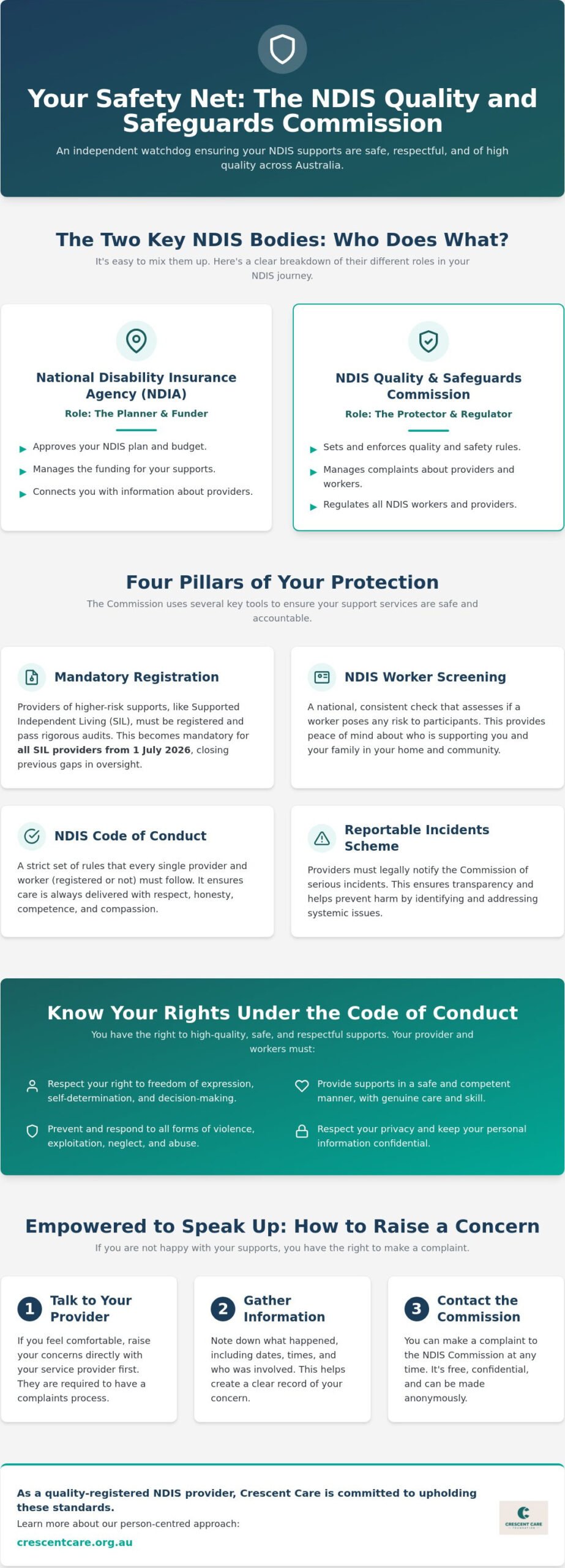
It’s common to mix these two up, but they serve very different purposes in your life. The National Disability Insurance Agency (NDIA) is essentially the manager of the scheme’s funding. They’re the ones who look at your goals, approve your plan, and make sure the money is there to pay for your supports. You can think of the NDIA as the “bank” or the “planner” of the system.
The Commission, on the other hand, acts like an ombudsman or a safety regulator. They don’t handle your budget, but they do handle the people you hire. If the NDIA is the bank, the Commission is the police and the quality control team rolled into one. Both agencies work together to support you, but the Commission is specifically where you go when the quality of your care isn’t what it should be. They’re your advocates for better standards.
Who the Commission Regulates
The Commission’s reach is broad, covering almost everyone involved in delivering your supports. This includes:
- Registered providers who undergo regular, rigorous audits.
- Unregistered providers, who still must follow the NDIS Code of Conduct.
- Individual support workers, even those working independently.
- Providers of high-intensity supports and complex care delivery.
As of 1 July 2026, all Supported Independent Living (SIL) providers are now required to be registered. This is a major step forward for safety. It means that whether you’re receiving help with household tasks or living in specialist accommodation, the ndis quality and safeguards commission is actively watching to ensure you’re in good hands. They’re committed to ensuring that no provider, no matter how small or large, is beyond the reach of the law.
How the Commission Protects Your Family in 2026
Safety isn’t just a feeling. It’s a set of rigorous, enforceable standards designed to keep your family secure and respected. The NDIS Quality and Safeguards Commission ensures that the people coming into your home are vetted and the organisations you trust are held to account. By mid-2026, these protections have become even more robust. The mandatory registration of all Supported Independent Living (SIL) providers from 1 July 2026 means that thousands more workers now fall under the full scope of the NDIS Practice Standards, closing previous gaps in oversight.
Transparency is the foundation of trust in any care relationship. Providers are legally required to notify the Commission of “reportable incidents,” such as accidents, injuries, or allegations of misconduct. This system ensures that nothing is hidden behind closed doors and that every incident is investigated to prevent it from happening again. Additionally, the Commission provides tight oversight on restrictive practices. Any strategy used to manage complex behaviours must be a last resort, always prioritising your dignity and seeking to reduce the need for such measures through positive, person-centred support.
The NDIS Worker Screening Check
Inviting someone new into your private space can be daunting. The national worker screening check is a crucial safeguard that provides peace of much-needed peace of mind for families in Liverpool and Bankstown. Unlike older, state-based systems, this national clearance follows a worker wherever they go in Australia. It’s a live, monitored system. If a worker’s police record or conduct status changes, the ndis quality and safeguards commission is alerted immediately. If you’re just starting your journey and want to know more about how these safety checks fit into your plan, you can review the ndis eligibility requirements for a clearer picture of access.
Monitoring High-Intensity Supports
For those requiring more complex medical or physical help, the stakes are naturally higher. The Commission places extra scrutiny on providers offering high-intensity support, such as tracheostomy care or complex seizure management. This ensures that every nurse or support staff member has the specific, verified training required for your clinical safety. In 2026, the Commission conducts regular, data-driven audits to ensure these providers meet the latest quality benchmarks. It’s about making sure your unique needs are met with the highest level of professional expertise and genuine care, so you can focus on living your life to the fullest.
Your Rights Under the NDIS Code of Conduct
The NDIS Code of Conduct isn’t just a list of rules for providers to follow; it’s a promise to you that your humanity will always come first. Every person who provides you with support, whether they are a registered organisation or an individual worker, must abide by these standards. The NDIS Quality and Safeguards Commission enforces this Code to ensure that you are never treated as just a number in a system. Your rights are the foundation of every service you receive, and understanding them is the first step toward true independence.
At its heart, the Code insists that you be treated with dignity and respect at all times. This means your support team should honour your choices, listen to your preferences, and recognise your unique strengths. You have the right to freedom of expression and self-determination, which is a fancy way of saying you get to be the boss of your own life. Providers are also legally required to deliver services in a safe and competent manner, using their professional skills to help you thrive without risk of harm. Privacy and confidentiality are mandatory, not optional extras; your personal information and your life behind closed doors must always be protected.
Cultural Safety for CALD and Arabic-Speaking Families
Respecting your background is a core part of the 2026 standards. The Code requires providers to offer support that is culturally safe, meaning they must respect your traditions, language, and family values. For Arabic-speaking homes in Sydney, this might mean having workers who understand your heritage or ensuring that complex information is explained in your first language. We believe that care is only truly high-quality when it feels like a natural fit for your life. If you are looking for a team that understands these nuances, our guide on NDIS help for Arabic speakers Sydney offers deeper insights into finding the right match for your family.
Empowerment Through Information
Knowledge is your most effective tool for staying safe and in control. The ndis quality and safeguards commission provides resources in many different languages to help you understand what you should expect from your providers. These organisations have an obligation to explain their services clearly, without using confusing jargon that leaves you feeling lost. Informed consent is the fundamental right to receive clear, honest information about your care options so you can make decisions that truly align with your goals and values. When you have the right information, you have the power to lead your journey with confidence.
How to Raise a Concern or Make a Complaint
Speaking up about your care can feel intimidating. You might worry about hurting someone’s feelings or, even worse, losing the vital support you rely on every day. Please know that your voice is your most powerful tool for staying safe. The ndis quality and safeguards commission exists specifically to listen to these concerns and ensure they are addressed with the seriousness they deserve. Whether you are a participant, a family member, or even a concerned member of the public, you have the right to raise your hand when something doesn’t feel right.
One of the most common hurdles is the fear of repercussions. To protect you, the Commission allows for anonymous complaints. If you’re worried about how a provider might react, you don’t have to provide your name. Every report is a vital step toward a safer disability sector for everyone in our community. If English isn’t your first language, you don’t have to struggle alone. You can access the Translating and Interpreting Service (TIS National) to help you share your story clearly and accurately. The Commission is legally required to take every complaint seriously and investigate whenever it’s necessary to keep people safe.
The 5-Step Complaint Process
Taking that first step is much easier when you know exactly what to expect. Here is how the journey toward a resolution usually looks:
- Speak to your provider: If you feel safe and comfortable doing so, try talking to the organisation first. Many issues can be resolved through a simple, honest conversation.
- Contact the Commission: If you don’t feel safe talking to them, or if the problem continues, call 1800 035 544 or use the online form.
- Provide the details: Share what happened, when it occurred, and who was involved. The more specific you can be, the better they can assist you.
- Assessment: The Commission will review your information. They may contact the provider to get their perspective or ask for further evidence.
- Resolution: You’ll receive a final update or a resolution. This could result in the provider changing their practices or, in serious cases, facing penalties.
Support for Refugees and New Migrants
If you’ve recently arrived in Australia, the system can feel especially overwhelming. You might worry that making a complaint could affect your visa or your residency. We want to reassure you that your safety comes first. Making a legitimate complaint about your care will never impact your visa status or your funding. There are specialised advocacy services available to walk beside you and help you navigate these conversations. For those just beginning their journey, we offer NDIS application help for refugees Sydney to get you started on a safe and supportive path.
You deserve to feel empowered and heard in every aspect of your care. If you need a partner who truly prioritises your safety and dignity, please contact the friendly team at Crescent Care today to see how we can support your goals.
Choosing a Quality-Registered Provider in Sydney
Finding the right support in Sydney is about more than just checking a list of available services. It’s about finding a team that respects your home, your culture, and your future. While the ndis quality and safeguards commission provides the essential safety net, the provider you choose is the one who will walk beside you every day. A registered provider isn’t just someone who has filled out a form; they are organisations that have opened their doors to independent auditors to prove they meet the highest possible standards of care.
When you’re looking for support, don’t be afraid to ask the tough questions. A quality provider should be transparent about how they manage feedback and what their safety record looks like. You might consider asking potential partners:
- How do you support your staff to handle complex or high-intensity situations?
- What is your process if I’m not happy with a particular support worker?
- Can you show me how you meet the latest 2026 NDIS Practice Standards?
- How do you ensure your support is culturally safe for my family?
A team that truly cares will welcome these questions. They’ll see them as a sign that you are taking charge of your journey, which is exactly what the NDIS is designed to encourage. For families in Sydney’s diverse communities, specialisation is key. Whether you need high-intensity support for medical needs or a team that understands the nuances of your cultural background, your provider should feel like a partner. They shouldn’t just deliver a service; they should facilitate your independence and advocate for your rights at every turn.
Why Registration Matters for Your Safety
Registration is a badge of accountability that shouldn’t be overlooked. It means a provider must have a formal internal complaints system and a clear, documented process for managing any incidents that occur. This structure ensures that if something goes wrong, there is a clear, legal pathway to fix it. Crescent Care is a registered NFP provider, and we’ve dedicated ourselves to exceeding the safety benchmarks set by the ndis quality and safeguards commission. We believe that being a non-profit allows us to keep our focus exactly where it belongs: on the well-being and dignity of the people we serve.
Your Next Steps to Secure Support
Your safety is an ongoing journey, not a destination. We encourage you to take a moment to review your current supports against the NDIS Code of Conduct we’ve explored in this guide. If you feel like your current arrangements aren’t meeting those standards, or if you’re feeling overwhelmed by the choices available, help is at hand. You can reach out for help navigating the ndis for CALD families to ensure your providers are working for you. Alternatively, Contact Crescent Care today to discuss how we can provide the safe, compassionate, and culturally respectful support your family deserves.
Leading Your Life with Confidence and Security
Your safety and dignity are the heart of everything the NDIS stands for. By understanding the role of the ndis quality and safeguards commission, you’ve taken a vital step toward ensuring your voice is always heard and your rights are always respected. We’ve explored how the 2026 standards provide a stronger safety net, the power of making a complaint, and the peace of mind that comes from choosing a partner who values your cultural heritage as much as your clinical needs.
You don’t have to navigate this complex system alone. When you choose a provider who prioritises transparency and compassion, you aren’t just receiving a service; you’re building a partnership based on trust. As an ACNC-registered Not-For-Profit and NDIS Registered Provider, we specialise in high-intensity CALD support tailored to your unique story. We’re here to walk beside you, ensuring every support you receive is safe, respectful, and designed to help you thrive.
Partner with a registered NDIS provider you can trust—contact Crescent Care today. We look forward to supporting your journey toward a life of independence and joy.
Frequently Asked Questions
Is the NDIS Quality and Safeguards Commission part of the NDIA?
No, they are two completely different agencies with separate roles in your life. The NDIA is responsible for managing the scheme’s funding and approving your individual plan; while the ndis quality and safeguards commission is the independent watchdog that regulates providers and workers. Think of them as a team where one handles the budget and the other ensures the quality and safety of the people you hire.
Can I make a complaint to the Commission in Arabic?
Yes, you can certainly make a complaint in Arabic or any other language you feel comfortable using. You can access the Translating and Interpreting Service (TIS National) by calling 131 450 to help you speak with the Commission. It’s vital that you can share your story clearly in your first language so that your concerns are understood and addressed with total accuracy.
What happens after I make a complaint about an NDIS provider?
Once you submit a report, the Commission assesses the information to decide on the best path forward. They might contact the provider for their side of the story, ask you for more details, or start a formal investigation if the situation is serious. The goal is always to find a resolution that keeps you safe and ensures the provider improves their standards or faces penalties for breaches.
Do I have to be a registered provider to work in the NDIS?
It depends on the specific type of support you are delivering to participants. While many providers operate as unregistered, certain services like Supported Independent Living (SIL) must be registered with the ndis quality and safeguards commission from 1 July 2026. Registration is also mandatory for anyone delivering high-intensity supports or using restrictive practices, as these areas require the highest level of government oversight.
What is an NDIS Worker Screening Check and why is it important?
This is a national clearance that ensures people working in risk-assessed roles don’t have a history of harm or misconduct. It’s a key safeguard because it follows workers across every state and territory in Australia, meaning their record is constantly monitored. This gives you peace of mind that the person supporting you in your home has been thoroughly vetted and cleared to work with vulnerable people.
Can the Commission help me get more funding in my NDIS plan?
No, the Commission doesn’t have the power to change your funding levels or approve your NDIS plan. If you feel you need more support in your budget, you’ll need to speak with the NDIA or your local area coordinator. The Commission’s only focus is making sure the services you already have are safe, respectful, and meet the high-quality standards you deserve.
What should I do if I am unhappy with my support coordinator?
You should start by having a calm conversation with your coordinator or their manager to see if the relationship can be improved. If you don’t feel comfortable doing this, or if the issues continue, you can lodge a formal complaint with the Commission. You have every right to work with a coordinator who truly understands your goals and treats your family with genuine respect.
Are there specific 2026 changes to NDIS safety rules I should know about?
The most significant change in 2026 is the mandatory registration for all SIL and digital platform providers starting 1 July. There are also new practice standards specifically for SIL that were co-designed with people with disability to improve safety in shared living. Additionally, the first wave of 5-year worker screening checks began expiring in early 2026, meaning providers are currently managing mass renewals to keep their teams compliant.